




The New World Order: How Middle East Tensions Are Reshaping Global Power
The United States, Russia and France in a Fragmenting World: Historical Lessons, Present Conflicts and the Future of Global Power
The New World Order: How Middle East Tensions Are Reshaping Global Power
The United States, Russia and France in a Fragmenting World: Historical Lessons, Present Conflicts and the Future of Global Power
By DNN7 International Affairs Desk | 21 October 2026
Is the World Entering a New Geopolitical Era?
The international system is experiencing a period of profound uncertainty. Military confrontation, strategic competition, energy insecurity, technological rivalry and the weakening of international trust are challenging assumptions that shaped global politics after the Cold War.
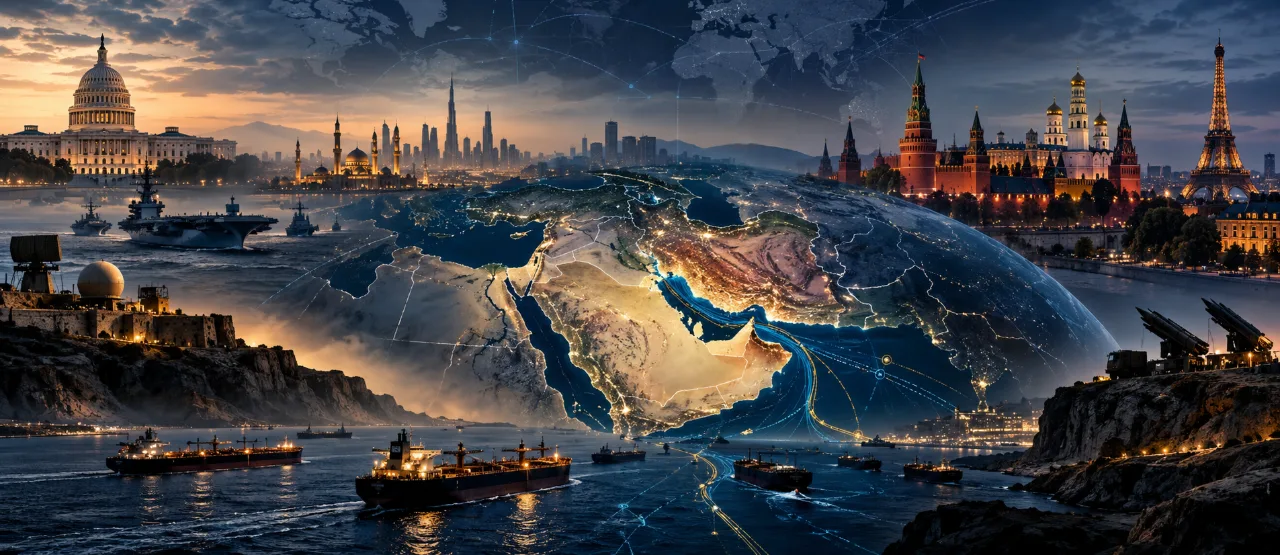
The Middle East has once again become a critical arena in this transformation. The confrontation involving the United States, Israel and Iran, the vulnerability of shipping through the Strait of Hormuz, continuing violence affecting Palestinians, and the wider regional involvement of armed groups have consequences far beyond the region itself.
According to Reuters reporting published on 20 October 2026, Washington and Tehran remain locked in difficult negotiations amid the economic and political consequences of the conflict that began in February. The same reporting describes the severe disruption to Iranian oil exports and the strategic importance of maritime pressure. Separately, the Associated Press has reported continuing regional instability, including Houthi attacks and additional British defensive support for Saudi Arabia.
These developments raise a fundamental question: are we witnessing the collapse of the existing international order, or the difficult birth of a new one?
The answer is unlikely to be simple. A new world order does not emerge merely because wars begin, alliances change or powerful leaders challenge one another. It emerges when the distribution of power, the rules governing international conduct and the institutions responsible for enforcing those rules undergo lasting change.
To understand the transformation now under way, we must examine history, the present geopolitical landscape and the possible futures that lie ahead.
1. What Does the New World Order Actually Mean?
The expression “New World Order” is frequently used in political speeches, television debates and social media. It can describe a genuine transformation in international relations, but it is also sometimes used as an imprecise label for secret plans or coordinated global control.
A serious geopolitical analysis must distinguish evidence from speculation.
In international relations, a world order consists of several interconnected elements:
Distribution of power: Which states possess the greatest military, economic, technological and diplomatic capabilities?
International rules: How are sovereignty, borders, trade, warfare and diplomatic relations governed?
Institutions: What roles do the United Nations, the World Trade Organization, regional organisations and financial institutions play?
Legitimacy: Do countries and populations consider the existing system fair, useful or worth defending?
Security arrangements: Which alliances, deterrence systems and regional agreements prevent or manage conflict?
The post-1945 system was shaped substantially by American economic and military power, the United Nations, the Bretton Woods institutions and, later, the expansion of international trade. During the Cold War, however, the United States and the Soviet Union competed within that wider framework.
Following the Soviet Union's dissolution in 1991, the United States enjoyed a period of exceptional global influence. That moment did not eliminate geopolitical competition. It temporarily altered the balance in Washington's favour.
Today, China's rise, Russia's confrontation with the West, regional powers' increasing ambitions, technological competition and doubts about the consistency of American commitments are putting pressure on the existing arrangement.
The emerging order may therefore be neither a simple return to the Cold War nor the arrival of a single replacement superpower. It could instead become a fragmented, multipolar system in which different countries dominate different regions, industries and strategic technologies.
2. The Historical Foundations of the Modern World Order
The Peace of Westphalia, 1648
The treaties commonly associated with the Peace of Westphalia are often treated as an important milestone in the development of the modern sovereign-state system.
They helped bring an end to the Thirty Years' War in Central Europe and contributed to the evolution of ideas about territorial authority and political independence.
However, the modern international system did not appear fully formed in 1648. Sovereignty, non-intervention and diplomatic equality developed gradually, and powerful states have repeatedly violated these principles.
The enduring lesson is that international order depends not only on written agreements but also on whether states accept the limits those agreements impose.
The Congress of Vienna, 1814–1815
After the Napoleonic Wars, European powers attempted to restore stability through a combination of diplomatic consultation, territorial settlements and a balance of power.
The resulting Concert of Europe was imperfect and frequently coercive. Nevertheless, it demonstrated that rival powers could sometimes manage their competition through negotiation rather than permanent war.
The system eventually weakened under the pressure of nationalism, imperial ambitions and competing strategic interests.
Its relevance today is clear: even when one political settlement becomes unsustainable, a replacement requires negotiation among actors who do not necessarily trust one another.
The First and Second World Wars
The First World War exposed the dangers of rigid alliances, arms races, nationalist mobilisation and catastrophic miscalculation. The peace settlement that followed failed to create a sufficiently stable and legitimate European order.
The Second World War produced a different institutional response.
The United Nations was founded in 1945, while the Bretton Woods institutions helped shape the postwar economic framework. The United States and the Soviet Union emerged as rival superpowers, creating a bipolar international system.
The central contradiction of this order was that institutions promoted collective security while the two leading powers simultaneously competed for strategic dominance.
The Cold War, 1947–1991
The Cold War demonstrated that intense competition between nuclear-armed powers did not always produce direct war between them.
Nuclear deterrence, intelligence operations, proxy conflicts, military alliances and economic competition shaped the international environment. The Cuban Missile Crisis of 1962 showed how rapidly confrontation could approach a catastrophic threshold.
The lesson is not that nuclear deterrence guarantees peace. It is that communication, crisis management and restraint can be essential when military escalation carries extraordinary costs.
The Post-Cold War Moment
The Soviet Union's collapse transformed the balance of power. The United States became the predominant military power, while globalisation and expanding international trade encouraged expectations of a more integrated world.
Yet the wars in Afghanistan and Iraq, the global financial crisis of 2008, the growing strategic importance of China and Russia's war against Ukraine exposed the limitations of assumptions about an increasingly peaceful and unified international system.
The current crisis should be understood against this longer historical background: the global system is being contested, but its replacement remains uncertain.
3. The Present Situation: The Middle East as a Strategic Pressure Point
The Middle East occupies a crucial position in international politics because it connects energy-producing regions, major shipping routes, military installations, religiously significant territories and competing regional security systems.
Its conflicts can influence the price of fuel, shipping costs, inflation, insurance premiums and the strategic calculations of governments across Asia, Europe and North America.
The United States and Iran: Military Pressure and Diplomacy
The confrontation between Washington and Tehran illustrates the limitations of military power as a tool for achieving long-term political objectives.
Reuters reported on 20 October 2026 that Iran was prolonging negotiations with the United States amid mutual distrust and the continuing consequences of the conflict that began in February. The reporting described American and Israeli military action against Iran, pressure on maritime trade and significant economic damage.
These developments do not mean that either side has achieved its ultimate strategic objectives.
The United States has substantial advantages in conventional military capabilities, intelligence, financial influence and global alliances. Iran, however, can impose costs through regional partnerships, asymmetric capabilities and its strategic position near the Strait of Hormuz.
The Strait is particularly important because disruption there can affect international energy markets even when most countries are not directly involved in the conflict.
The strategic dilemma is that military pressure may weaken an opponent's capabilities while simultaneously increasing its incentives to resist, retaliate or seek alternative partnerships.
The decisive question is whether negotiations can produce an arrangement that addresses security concerns, nuclear proliferation risks, maritime access and regional stability without requiring either side to accept politically impossible concessions.
Israel, Palestine and the Question of International Legitimacy
The Israeli-Palestinian conflict remains central to the region's political legitimacy crisis.
Security concerns, attacks against civilians, the status of Palestinian statehood, occupation, displacement, humanitarian access and the future governance of Gaza are not separate questions. They influence one another.
The credibility of the international system is tested when governments apply principles of sovereignty, civilian protection and international law inconsistently.
For many states and populations outside the Western alliance system, perceptions of double standards have weakened confidence in the idea that international rules are applied equally.
That does not mean every criticism of Western policy is justified, nor does it excuse violations committed by other actors. It means that the legitimacy of an international order depends on whether its principles are applied consistently, including when politically influential allies are involved.
A durable settlement will require more than temporary pauses in fighting. It will need credible security arrangements, meaningful political representation, humanitarian protection and a viable path towards resolving the underlying national and territorial questions.
The Gulf, Shipping and the Global Economy
The Strait of Hormuz illustrates how a geographically narrow maritime passage can have worldwide consequences.
Energy markets respond not only to the amount of oil physically lost but also to the probability of future disruption. When traders anticipate that supplies may be interrupted, prices can rise before a shortage becomes measurable.
Reuters reported on 18 October 2026 that Brent crude had closed at $109.86 per barrel on the preceding Friday, amid concerns about regional instability and supply constraints.
For energy-importing economies, including India, sustained disruption could increase import bills, transport costs and inflationary pressures. The impact would depend on the duration of the disruption, the availability of alternative supplies, currency movements and government policy responses.
The crisis also demonstrates why energy security is increasingly linked to national security. Diversified suppliers, strategic reserves, renewable energy, resilient electricity networks and reliable shipping arrangements can all reduce vulnerability.
4. Russia: Challenging Western Strategic Primacy
Russia's role in the emerging international order cannot be understood solely through its military actions in Ukraine or its relations with the United States.
Moscow seeks strategic influence, recognition of its security interests and a greater role in shaping European and global security arrangements. Its confrontation with Western governments has encouraged closer coordination with some non-Western states, although those relationships do not amount to a unified alliance on every issue.
Russia also possesses important sources of influence: nuclear capabilities, energy resources, military-industrial capacity, diplomatic relationships and a permanent seat on the United Nations Security Council.
However, strategic influence is not the same as unlimited power.
Russia faces constraints arising from the costs of war, sanctions, demographic pressures, economic concentration and the long-term requirements of technological development. Its relationship with China also involves an asymmetry of economic scale that could become increasingly significant.
The key question is whether Russia will seek a negotiated European security settlement or continue to pursue its objectives through coercion and prolonged confrontation.
Any credible new international order must account for Russian power without treating the invasion of another sovereign country as a legitimate entitlement. Security concerns can be negotiated; they do not automatically invalidate the sovereignty of neighbouring states.
Russia's future position will depend partly on the outcomes of the war in Ukraine, the sustainability of its economic model and its ability to maintain partnerships without becoming excessively dependent on a stronger strategic partner.
5. France: European Strategic Autonomy in a Fragmenting World
France occupies a distinctive position in the international system.
It is a nuclear-armed state, a permanent member of the UN Security Council, a member of NATO and the European Union, and a country with a long diplomatic and strategic history in the Mediterranean, Africa and the Middle East.
French policy must reconcile several priorities: European security, relations with Washington, strategic competition with Russia, energy security, regional stability and the preservation of diplomatic influence.
The concept of European strategic autonomy seeks to strengthen Europe's capacity to act when its interests are at stake. It does not necessarily mean abandoning NATO or ending cooperation with the United States.
Instead, it raises practical questions about defence production, intelligence, military readiness, energy supplies, industrial capacity and Europe's ability to make decisions without complete dependence on an external power.
France can contribute to diplomacy, nuclear deterrence, European defence cooperation and efforts to reduce regional escalation. Its influence, however, is constrained by domestic political pressures, fiscal limitations and the need to build agreement with other European governments.
The wider lesson is that a multipolar world is not automatically a world of equal powers. France may possess substantial diplomatic and military capabilities, but its influence is amplified when it operates through European institutions and partnerships.
If the United States becomes more selective about its international commitments, European governments will face a difficult choice: invest more in collective security, accept greater strategic dependence or attempt to develop a more independent foreign policy.
6. China, the BRICS Countries and the Multipolar Debate
The emerging international order cannot be explained by examining Washington, Moscow and Paris alone.
China is a central economic and technological power whose global position differs fundamentally from Russia's. Its manufacturing capacity, trade relationships, industrial policy and technological ambitions give it substantial influence over the direction of the world economy.
The BRICS grouping and other platforms for cooperation among non-Western states reflect dissatisfaction with aspects of the existing distribution of international power.
However, these countries do not share identical interests. India and China have significant strategic disagreements. Energy exporters and importers may approach regional crises differently. Countries seeking alternatives to Western financial institutions may still depend heavily on Western markets.
Multipolarity therefore should not be confused with the formation of a single anti-Western bloc.
It is better understood as the growing ability of several powers to influence international outcomes, sometimes cooperating and sometimes competing.
For India, this creates both opportunities and risks. A more diversified international system may expand diplomatic options and economic partnerships. Yet intensifying great-power rivalry can increase pressure to choose sides, complicate energy security and expose the country to supply-chain disruptions.
Strategic autonomy becomes more valuable when a country's economic resilience, military capabilities and diplomatic credibility allow it to make independent decisions.
7. What the Major Books Tell Us About World Order
Three important books provide different frameworks for interpreting the current transition. They should be read as competing analytical perspectives, not as definitive predictions.
Henry Kissinger — World Order (2014)
Kissinger examines the historical foundations of international order and the difficulty of reconciling different civilisational traditions, national interests and political principles.
His central contribution is the distinction between a distribution of power and an accepted system of rules. A system may be powerful without being universally legitimate, and an order may become unstable when leading actors no longer agree on its basic principles.
Applied to today's Middle East, the argument suggests that military victories alone cannot establish a durable settlement. Regional arrangements must be sufficiently acceptable to the states expected to uphold them.
John J. Mearsheimer — The Tragedy of Great Power Politics (2001; updated edition 2014)
Mearsheimer's offensive realism emphasises the uncertainty of international politics and the incentives that encourage great powers to seek security through relative power.
From this perspective, states cannot safely assume that competitors will remain peaceful or that institutions can eliminate strategic rivalry.
The framework helps explain why the United States seeks to preserve its strategic position, why Russia resists what it perceives as an unfavourable security environment, and why China is likely to seek greater regional influence.
However, realism does not prove that every conflict is inevitable. Domestic politics, economic interdependence, leadership decisions and diplomacy can influence how competition unfolds.
Zbigniew Brzezinski — The Grand Chessboard (1997)
Brzezinski focused on Eurasia as a central arena of geopolitical competition, emphasising geography, alliances and the strategic importance of the Eurasian landmass.
His framework remains useful for understanding the connections between European security, Russia's strategic ambitions, China's rise and the international importance of Central Asia and the Middle East.
The contemporary geopolitical landscape is more technologically interconnected than the world of 1997. Nevertheless, geography still matters because energy infrastructure, military logistics, ports and transport corridors cannot be separated from political power.
Francis Fukuyama — The End of History and the Last Man (1992)
Fukuyama's argument about the ideological direction of history is frequently reduced to the claim that wars and political conflict had ended. That is not an accurate summary of his broader thesis.
His work explored the possibility that liberal democracy had emerged as the most influential surviving model of political legitimacy after the Cold War.
The subsequent resurgence of authoritarian governance, nationalism and great-power rivalry has challenged optimistic interpretations of that moment.
The lesson is not necessarily that democratic institutions have failed, but that no political model can be assumed to remain secure without public legitimacy, institutional resilience and the capacity to address economic and social pressures.
Reading the Books Together
These authors illuminate different dimensions of international politics:
Kissinger emphasises the relationship between power and legitimate order.
Mearsheimer emphasises strategic competition and insecurity.
Brzezinski emphasises geography and Eurasian power.
Fukuyama examines political legitimacy and ideological development.
Taken together, they suggest that the next international order will be shaped by the interaction of military strength, economic capacity, geography, domestic politics and the acceptance—or rejection—of common rules.
8. Three Possible Futures for the World Order
No analyst can predict the future with certainty. The following scenarios represent plausible pathways, not guaranteed outcomes.
Scenario One: A Negotiated Multipolar Order
In this scenario, the major powers recognise that prolonged confrontation imposes costs that exceed the benefits of escalation.
The United States and Iran reach a framework for reducing hostilities and restoring predictable maritime access. Regional governments establish stronger mechanisms for crisis communication. European states expand defence capabilities while maintaining cooperation with NATO. Russia and Western governments eventually pursue a negotiated framework for European security.
China, India and other major economies participate in more representative international institutions.
Such an order would remain competitive. Its defining feature would be the existence of mechanisms capable of managing competition without allowing every dispute to become a military confrontation.
The main obstacle is political trust. Leaders may find compromise difficult to defend domestically, particularly when their governments have invested heavily in confrontational rhetoric.
Scenario Two: Competing Regional Blocs
In this scenario, international cooperation becomes increasingly selective.
The United States strengthens security partnerships in strategically important regions. Russia consolidates relationships with countries willing to cooperate despite Western sanctions. China expands its economic and technological influence. European governments invest more heavily in defence, while India and other middle powers attempt to preserve room for independent decisions.
Trade continues, but sensitive technologies, energy systems, financial networks and defence industries become more divided.
The result would be neither complete globalisation nor total economic separation. It would be a fragmented system in which countries maintain commercial relations while restricting strategic dependencies.
This scenario is plausible because governments can pursue national security objectives without completely abandoning international trade. Its danger is that competing blocs may interpret defensive measures as offensive preparations, creating a cycle of mistrust.
Scenario Three: Prolonged Escalation and Systemic Instability
In the most dangerous scenario, negotiations repeatedly fail and regional confrontations spread.
Disruption to shipping and energy supplies increases economic pressure. Military incidents trigger retaliatory action. Domestic political incentives discourage compromise. Cyber operations and attacks on critical infrastructure complicate efforts to distinguish limited conflict from broader escalation.
Great powers may not intend to fight one another directly, yet their commitments to partners and their concerns about credibility could draw them deeper into regional confrontations.
This scenario would increase the risks of miscalculation, humanitarian catastrophe and wider economic disruption.
It is not inevitable. Crisis communication, restraint, credible deterrence and sustained diplomatic engagement can reduce these dangers. But avoiding direct war requires more than assuming that all leaders will act rationally under pressure.
9. What Will Determine the Next World Order?
Five factors will be particularly important.
First, the outcome of the Middle East crisis. A durable settlement would demonstrate that military confrontation can give way to negotiated arrangements. Continued escalation would strengthen the perception that regional security is determined primarily by coercive power.
Second, the future of the US-led alliance system. The consistency of American commitments will influence how allies allocate defence resources and how competitors calculate strategic risk.
Third, the trajectory of Russia's war against Ukraine. Its outcome will shape European security, the credibility of deterrence and Russia's long-term relationship with Western states.
Fourth, China's economic and technological position. Leadership in advanced manufacturing, artificial intelligence, semiconductors, energy systems and industrial infrastructure may translate into substantial geopolitical influence.
Fifth, the legitimacy of international institutions. If states believe that rules are selectively applied, they will have less incentive to defend those rules. Institutional reform and consistent enforcement may therefore be as important as military capability.
A sixth factor deserves equal attention: the resilience of domestic political systems. Economic inequality, public distrust, polarisation and institutional weakness can constrain foreign policy and make international commitments less predictable.
10. India and the Global South: Navigating the Transition
For India and other countries that seek strategic autonomy, the emergence of a more competitive world presents a complex challenge.
India has important relationships with the United States, Russia, France, Europe, the Gulf countries and Israel, while also maintaining significant economic and diplomatic interests across Asia and the wider Global South.
The objective is not to avoid every disagreement or maintain identical relations with every power. It is to preserve the ability to make decisions according to national interests while respecting international law.
Energy security is one immediate concern. Prolonged instability in the Strait of Hormuz can raise the cost of imports and place pressure on domestic prices. Supply diversification, strategic reserves and investment in reliable alternatives can reduce exposure.
Defence procurement and technology partnerships present another challenge. Excessive dependence on a single supplier can create vulnerabilities, while completely replacing established systems may be expensive and impractical.
India can also support a more representative international order through multilateral diplomacy, development cooperation, regional dialogue and advocacy for reforms that reflect the interests of a wider range of countries.
The Global South is not a single political bloc. Its influence will depend on whether countries can cooperate on shared interests without ignoring their differences.
11. Is a New World Order Inevitable?
Some transformation is already visible in the changing distribution of economic and military power. But it would be premature to declare that the existing international system has disappeared or that a particular replacement has already been established.
A new world order is not a secret blueprint waiting to be revealed. It is the cumulative result of state decisions, economic changes, institutional reforms, technological developments and historical contingencies.
Military power matters, but so do productive capacity, energy resilience, scientific innovation, diplomatic credibility and public legitimacy.
The United States may remain a leading power without enjoying the same freedom of action it possessed at the end of the Cold War. Russia may retain significant military and diplomatic influence while facing substantial economic and strategic constraints. France and its European partners may seek greater autonomy without abandoning transatlantic cooperation. China may expand its influence without replacing every function of the existing international system.
The final outcome will depend on how these powers respond to one another—and whether they can recognise limits before competition becomes uncontrolled escalation.
The Future Will Be Contested, Not Predetermined
The present geopolitical crisis is part of a much longer transformation in international politics.
History shows that international orders rarely remain unchanged forever. The Westphalian settlement, the Concert of Europe, the post-1945 institutions and the post-Cold War system each reflected a particular distribution of power and a particular set of political expectations.
The Middle East now reveals the fragility of those expectations. Conflict in the region can affect energy markets, international trade, domestic politics and the credibility of global institutions. At the same time, Russia's confrontation with the West, China's growing influence and Europe's search for strategic autonomy are reshaping the wider balance.
The central question is not simply which country will become the next global hegemon. It is whether the leading powers can construct a system in which competition remains manageable, smaller states retain meaningful sovereignty, civilians receive protection and international rules have credibility beyond political convenience.
A multipolar world could offer more diplomatic choices and a more representative distribution of influence. It could also become more dangerous if competing powers reject common limits.
The future world order will therefore not be determined by military strength alone. It will be determined by the relationship between power, legitimacy, institutions and restraint.
The decisive contest of the coming years may be between two political possibilities: a world in which power is balanced by rules, or a world in which rules survive only when powerful states find them convenient.
The choice is not entirely in the hands of any single country. It will emerge from the decisions—and the mistakes—of many.
References and Further Reading
Kissinger, Henry. World Order. Penguin Press, 2014.
Mearsheimer, John J. The Tragedy of Great Power Politics. W. W. Norton, 2001; updated edition, 2014.
Brzezinski, Zbigniew. The Grand Chessboard: American Primacy and Its Geostrategic Imperatives. Basic Books, 1997.
Fukuyama, Francis. The End of History and the Last Man. Free Press, 1992.
United Nations. Charter of the United Nations, 1945.
Reuters, 20 October 2026. Reporting on US-Iran negotiations and the strategic consequences of the conflict.
Reuters, 18 October 2026. Reporting on Gulf financial markets, oil prices and regional tensions.
Associated Press, October 2026. Reporting on regional security developments, Houthi attacks and defensive military support in the Middle East.
Editorial note: This article distinguishes established historical events, reported current developments and analytical scenarios. Forecasts are conditional assessments, not claims of certainty. Current-affairs details should be updated against the latest reporting before republication.
Official Editorial PDF Edition
Verified PublicationDownload a clean, high-resolution printable copy complete with tables, formulas, and high-res photography. Free for registered readers.
Community Feedback & Editorial Ratings
All Reader Reviews (0)
No reader reviews yet for this story.
Be the first to share your rating and perspective!