







The Capitalist Game Behind Communism: A New Mask for Power?
A critical examination of communism, capitalism, state power and elite control through the works of Plato, Marx, Lenin, Popper, Hayek and Michels.
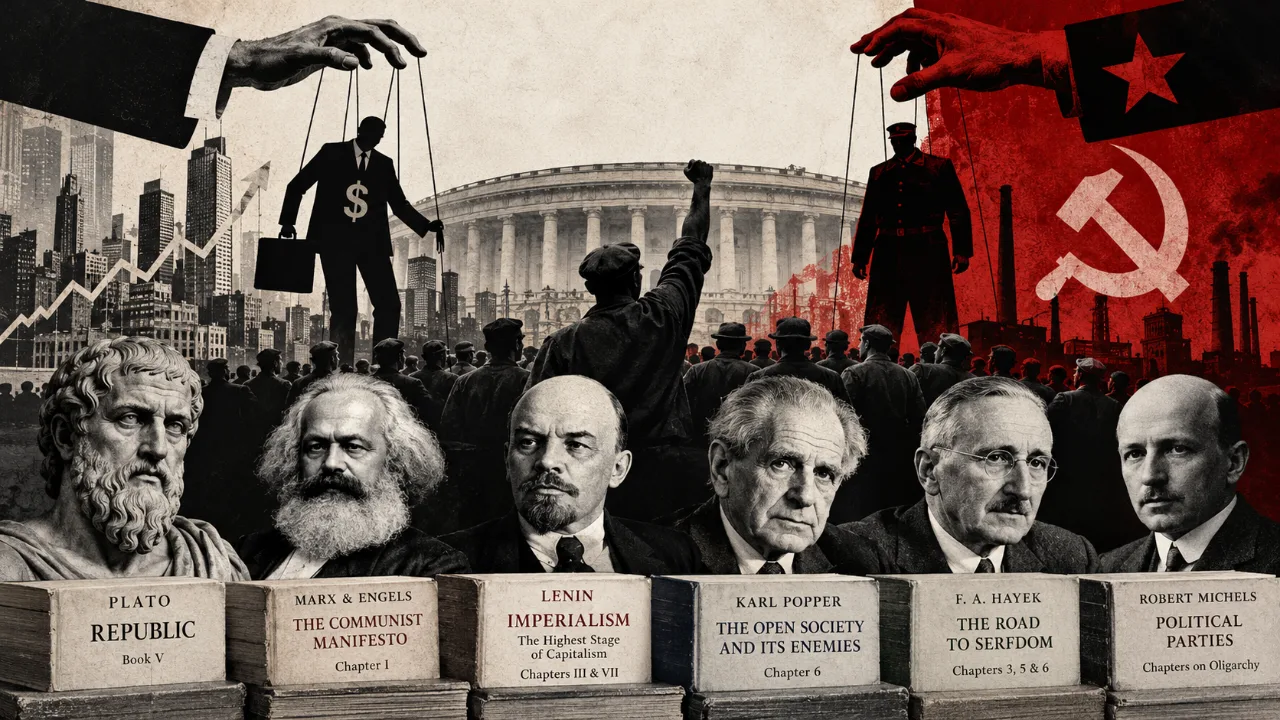
The Capitalist Game Behind the Promise of Equality: Is Communism a New Mask for Power?
From Plato’s Republic to Marx’s class struggle, Lenin’s theory of imperialism, Karl Popper’s critique of political utopianism, Friedrich Hayek’s warnings about central planning, and Robert Michels’s theory of oligarchy—an editorial examination of communism, capitalism, and the concentration of power.
1. The Question That Rarely Gets Asked
One of the most attractive promises in political history is the vision of a society without exploitation, class divisions, or the monopoly of productive resources by a privileged minority. This vision is associated with communism.
But an important question remains: if the objective is to eliminate the concentration of wealth and power, why have some states established in the name of equality created new powerful classes? Why have political parties claiming to represent workers sometimes exercised extensive control over those same workers? And why has opposition to private capitalist ownership occasionally resulted in the state becoming the dominant employer, resource allocator, and economic controller?
These questions cannot be answered simply by blaming capitalism. Nor would it be intellectually convincing to dismiss every egalitarian ideal as a deception. A serious examination must ask: Who owns the resources? Who makes the decisions? Who benefits from production? And who has the authority to hold those in power accountable?
The central argument of this editorial is that systems established in the name of communism can, under certain conditions, reproduce power relationships resembling capitalist domination. If private capitalists are replaced by a powerful party bureaucracy or a state-controlled elite, while ordinary people remain excluded from meaningful decision-making, the structure of domination may change its appearance without disappearing.
One qualification is essential. There is no broadly accepted historical evidence establishing that capitalists secretly created or control communism as a unified global conspiracy. The more productive question is whether economic interests and privileged groups can survive, adapt, or benefit within systems that publicly oppose capitalism.
2. Plato’s Republic: Equality or an Experiment in Elite Governance?
The ancient Greek philosopher Plato’s Republic is one of the most influential works in political philosophy. Through dialogues featuring Socrates, the work examines justice, education, political authority, and the organisation of an ideal society.
In Book V, Plato proposes restrictions on private property and family arrangements for the guardian classes responsible for governing and defending the ideal city. His reasoning is that personal wealth, family interests, and private economic incentives could distract rulers from their public responsibilities.
Book reference: Plato, Republic, translated by G. M. A. Grube and revised by C. D. C. Reeve, Hackett Publishing, 1992, Book V, beginning around p. 122; relevant passages include Stephanus 457c–466d.
However, Plato’s proposal should not be equated directly with modern communism. His restrictions apply primarily to the guardian classes, not uniformly to every member of society. The producing class in his ideal city retains private property. This distinction is essential to understanding his political philosophy.
The deeper question is whether restricting a ruler’s private wealth is enough to prevent the abuse of power.
Without independent oversight, legal constraints, and the right to question authority, even a ruler without personal property can become powerful and self-interested.
Plato recognised that private interests could undermine public justice. Modern political experience, however, suggests another possibility: political authority itself can become a source of privilege.
A ruler who does not personally own a factory may still control employment, production targets, housing allocation, public resources, and access to opportunities. If these powers cannot be challenged, the absence of private ownership does not automatically guarantee freedom.
The question, therefore, is not simply whether rulers own property. It is whether the people have effective mechanisms to control their rulers.
3. Marx’s Theory of Capitalism: An Enemy or a Historical Precondition?
Karl Marx and Friedrich Engels’s Manifesto of the Communist Party played a foundational role in the development of modern communist political thought.
In its first chapter, “Bourgeois and Proletarians,” the authors examine the relationship between the capitalist class, which controls the means of production, and the working class, which sells its labour to earn a living.
Book reference: Karl Marx and Friedrich Engels, Manifesto of the Communist Party, in Marx/Engels Selected Works, Volume One, Progress Publishers, Moscow, 1969, pp. 98–137, especially Chapter I, “Bourgeois and Proletarians.”
Marx’s analysis treats capitalism not merely as a moral problem but as a historical system of production, property ownership, labour relations, and class power.
According to Marx, the relationship between capital and labour creates conditions under which capitalists appropriate surplus value generated through production. His analysis therefore focuses on the structure of economic relationships rather than simply the personal morality of individual business owners.
Yet an important aspect of Marx’s historical perspective is frequently overlooked: capitalism also develops productive forces, industrial systems, and social relationships that influence the possibilities for future economic transformation.
This creates a critical question. If a revolution dismantles capitalist ownership but transfers control over production to a centralised political party rather than to workers themselves, where does the promised liberation of labour actually occur?
Removing private capitalists does not necessarily give workers meaningful authority over production. If the state unilaterally determines wages, employment, production targets, and resource allocation, workers may remain economically dependent on an authority they cannot effectively challenge.
This criticism does not invalidate every aspect of Marx’s analysis. Instead, it invites us to examine the gap between the stated objective of emancipation and the actual institutional arrangements of certain historical regimes.
4. Capital Changes Its Form, but Does the Logic of Power Change?
Capitalism is generally associated with private ownership, markets, profit, and capital accumulation. However, economic power does not operate exclusively through privately owned corporations.
When a state controls production, credit, employment, supply chains, and the distribution of essential resources, it can exercise enormous influence over people's lives.
The concept of state capitalism is relevant here, although it must be used carefully. Not every state-owned enterprise is capitalist, and not every planned economy operates in the same way. The important questions concern who controls economic decisions, whose interests those decisions serve, and whether citizens can meaningfully challenge that authority.
Imagine a system in which senior officials cannot personally sell state-owned factories but exercise extensive control over appointments, housing, permits, employment, procurement, and access to resources.
Even without conventional private ownership, such officials may enjoy substantial privileges. Their power may arise from their institutional position rather than from shares, factories, or land held in their own names.
This suggests that economic power should not be understood solely as the possession of money. Control over productive assets, access to resources, and influence over economic decisions can also create powerful advantages.
Consequently, a political system cannot be judged simply by the percentage of the economy owned by the state or by the language used in its manifesto.
Can workers organise independently? Can they criticise government policy? Can they establish independent trade unions? Can they influence production and employment decisions without seeking permission from the ruling party?
If the answers are consistently negative, the promise of equality may coexist with a new concentration of power.
5. Lenin’s Imperialism: A Marxist Critique of Concentrated Capital
Interestingly, the critique of concentrated economic power has not come only from defenders of capitalism. Vladimir Lenin examined monopolies, banking, industrial concentration, and financial oligarchy in Imperialism, the Highest Stage of Capitalism.
Book reference: V. I. Lenin, Imperialism, the Highest Stage of Capitalism, Lenin's Selected Works, Volume 1, Progress Publishers, Moscow, 1963, pp. 667–766. Particularly relevant are Chapter III, “Finance Capital and the Financial Oligarchy,” and Chapter VII, “Imperialism as a Special Stage of Capitalism.”
Lenin argued that capitalism could develop towards a stage in which large monopolistic enterprises, banks, and financial groups accumulated disproportionate economic influence.
A market might formally contain many businesses while actual economic power remained concentrated in a relatively small number of institutions.
This analysis raises a further question: if a state claims to oppose private monopolies but itself becomes the exclusive controller of major productive resources and economic decisions, what remedies remain available to citizens against that monopoly of authority?
Lenin’s theory should not be presented as evidence that capitalists secretly control communism. Rather, it provides a framework for examining the concentration of economic power—a question that can also be applied critically to state-controlled economic systems.
The identity of the institution holding power may change. The fundamental question remains whether that power is accountable.
6. Karl Popper: The Danger of Losing Freedom in the Name of an Ideal Society
In The Open Society and Its Enemies, philosopher Karl Popper criticised political doctrines that claim to know history’s ultimate destination and seek to reorganise society around that supposedly inevitable future.
A substantial part of his argument examines Plato’s political philosophy.
Book reference: Karl R. Popper, The Open Society and Its Enemies, Princeton University Press, 1994 edition, Chapter 6, “Totalitarian Justice,” pp. 83–113. Pagination varies between editions.
The danger Popper identifies is the belief that political leaders possess privileged knowledge of history’s true laws and society’s ultimate good.
Once rulers claim to understand what humanity must ultimately become, opposition can be portrayed as an obstacle to historical progress rather than as a legitimate expression of disagreement.
In such circumstances, political dissent ceases to be treated as a normal democratic right. It can instead be labelled reactionary, disloyal, or hostile to the people.
Popper’s argument offers an important test for any political ideology: does it preserve the right to criticise authority, maintain independent institutions, support a free press, and allow peaceful political change?
However, Popper’s interpretation of Plato is itself debated. Reducing Plato’s entire political philosophy to a blueprint for totalitarianism would overlook his broader discussions of justice, education, and moral responsibility.
The purpose of philosophical criticism is to deepen an argument, not reduce a complex thinker to a convenient political slogan.
7. Robert Michels: Why Can Egalitarian Organisations Produce New Elites?
Robert Michels’s Political Parties is particularly relevant to understanding how power becomes concentrated inside organisations that claim to represent ordinary people.
Michels developed the idea commonly known as the “Iron Law of Oligarchy.” He argued that large organisations require administration, specialised knowledge, resources, and coordination. Over time, these requirements can give organisational leaders increasing control over information, strategy, and decision-making.
Book reference: Robert Michels, Political Parties: A Sociological Study of the Oligarchical Tendencies of Modern Democracy, Free Press, 1968 edition. Relevant discussions include “The Financial Power of the Leaders and of the Party,” beginning around p. 129, and “Democracy and the Iron Law of Oligarchy,” beginning around p. 342. Page numbers should be checked against the edition used.
The problem is not confined to communist parties. Trade unions, democratic parties, professional associations, and private organisations can all face risks of leadership becoming insulated from their members.
Ordinary members may lack the time, information, or resources to participate in every decision. Leaders, meanwhile, gain experience, institutional knowledge, and control over organisational communication.
As a result, an organisation established to represent its members can gradually become dominated by a small leadership group.
This is not an exceptionless law that makes democracy impossible. It is a warning about organisational incentives and institutional design.
If a political party claims to represent equality but its members cannot question its leadership, replace leaders through meaningful competition, or scrutinise its finances, a new privileged class may emerge.
The central lesson is that an organisation seeking to prevent concentrated power must continually examine its own power structure.
8. Friedrich Hayek: From Economic Control to Political Control
Friedrich Hayek examined the relationship between central economic planning and individual liberty in The Road to Serfdom.
His argument was that when a government attempts to direct an increasingly large proportion of economic activity, the authority required to enforce its decisions may also expand.
Book reference: F. A. Hayek, The Road to Serfdom: Text and Documents—The Definitive Edition, University of Chicago Press, 2007. Relevant chapters include Chapter 3, “Individualism and Collectivism”; Chapter 5, “Planning and Democracy”; and Chapter 6, “Planning and the Rule of Law.”
Hayek’s argument does not require us to accept that markets always produce just outcomes. Markets can fail, monopolies can exploit their positions, and unequal access to healthcare, education, and essential services can require public intervention.
Nevertheless, his question deserves consideration: if a central authority controls the most important economic decisions, how freely can an individual oppose that authority without risking employment, income, or access to essential resources?
This brings us back to the distinction between state ownership and public control.
The fact that resources are managed in the name of the state does not automatically mean that citizens exercise effective authority over those resources.
The key issue is whether public institutions remain accountable to the people whose lives they influence.
9. Are Capitalists Really Behind Communism?
We can now return to the central question: are capitalists the real force behind communism?
The claim that capitalists collectively and secretly created or control communism as a global project is not supported by broadly accepted historical evidence. It would therefore be misleading to present it as an established fact.
A more defensible question is whether groups with economic or political privileges can emerge within systems established in the name of equality—and whether those groups can preserve their advantages while publicly opposing capitalism.
The answer is that such concentration of power is possible and has been widely debated in the study of political and economic systems. But each country and historical period must be examined on its own evidence.
State-owned economies, social democracy, welfare states, revolutionary Marxist parties, and the theoretical concept of a fully communist society are not interchangeable categories.
Capitalists may benefit from certain political arrangements, economic instability, restricted competition, or weakened bargaining power among workers. State officials and party leaders may also gain privileges from controlling employment, resources, and institutions.
But the existence of possible beneficiaries does not prove that they deliberately designed or secretly control an entire ideology.
A rigorous investigation must distinguish between documented interests, unintended consequences, institutional incentives, and unsupported conspiracy claims.
The more important question is therefore this: In whose name is a political system operating, and who actually benefits from its decisions?
10. Five Questions for Evaluating the Promise of Equality
Any political system claiming to represent workers or establish social equality should be examined through five practical questions.
1. Who actually controls productive resources?
If assets are publicly owned, do workers and citizens have meaningful influence over production, investment, and distribution decisions?
2. How much freedom do workers possess?
Can workers establish independent organisations, negotiate wages, challenge unfair conditions, and protest without unreasonable retaliation?
3. Is political power accountable?
Can the decisions of political leaders be scrutinised through independent courts, free media, meaningful elections, and civil society?
4. How are opportunities and privileges distributed?
Does the system reduce inequality in practice, or does a privileged political or administrative class enjoy advantages unavailable to ordinary citizens?
5. Can the system correct its own mistakes?
Can failed policies be openly criticised and changed, or must evidence of failure be suppressed to protect the ideology?
Without answering these questions, it is premature to declare any system genuinely egalitarian, worker-oriented, or just.
Conclusion: Judge the Distribution of Power, Not the Name
Capitalism does not automatically guarantee freedom. Market concentration, economic inequality, and the disproportionate influence of wealthy groups remain serious challenges.
Likewise, a state established in the name of communism does not automatically create a society free from exploitation. If political authority becomes unaccountable, private economic domination may be replaced by party or bureaucratic domination.
Plato questioned the private interests of rulers. Marx analysed class relations and the organisation of production. Lenin examined financial concentration and monopoly. Popper warned about the dangers of imposing political ideals at the expense of freedom. Michels explored how leadership power can become concentrated within supposedly representative organisations. Hayek warned that extensive economic control could threaten political liberty.
These thinkers disagreed profoundly. Their arguments cannot be combined into a single, unified doctrine. Yet their disagreements help illuminate a common political problem: the relationship between power, accountability, and human freedom.
The proper test of communism is not merely its flag, slogan, or manifesto. Nor should capitalism be judged solely by its output or the volume of wealth it generates.
The relevant questions are whether people possess meaningful freedom, whether labour receives fair treatment, whether economic opportunities are accessible, and whether those in authority can be challenged.
Ultimately, human liberation does not reside in the name of an ideology. It depends on institutions, rights, and mechanisms of accountability that prevent any individual, party, state, or economic group from exercising unchecked power over society.
Official Editorial PDF Edition
Verified PublicationDownload a clean, high-resolution printable copy complete with tables, formulas, and high-res photography. Free for registered readers.
Community Feedback & Editorial Ratings
All Reader Reviews (0)
No reader reviews yet for this story.
Be the first to share your rating and perspective!