









Professor Mahesh Kakde Wins 2026 Ramanujan Prize for Groundbreaking Work in Mathematics
The IISc mathematician is honoured for major contributions to algebraic number theory and research on longstanding mathematical conjectures.
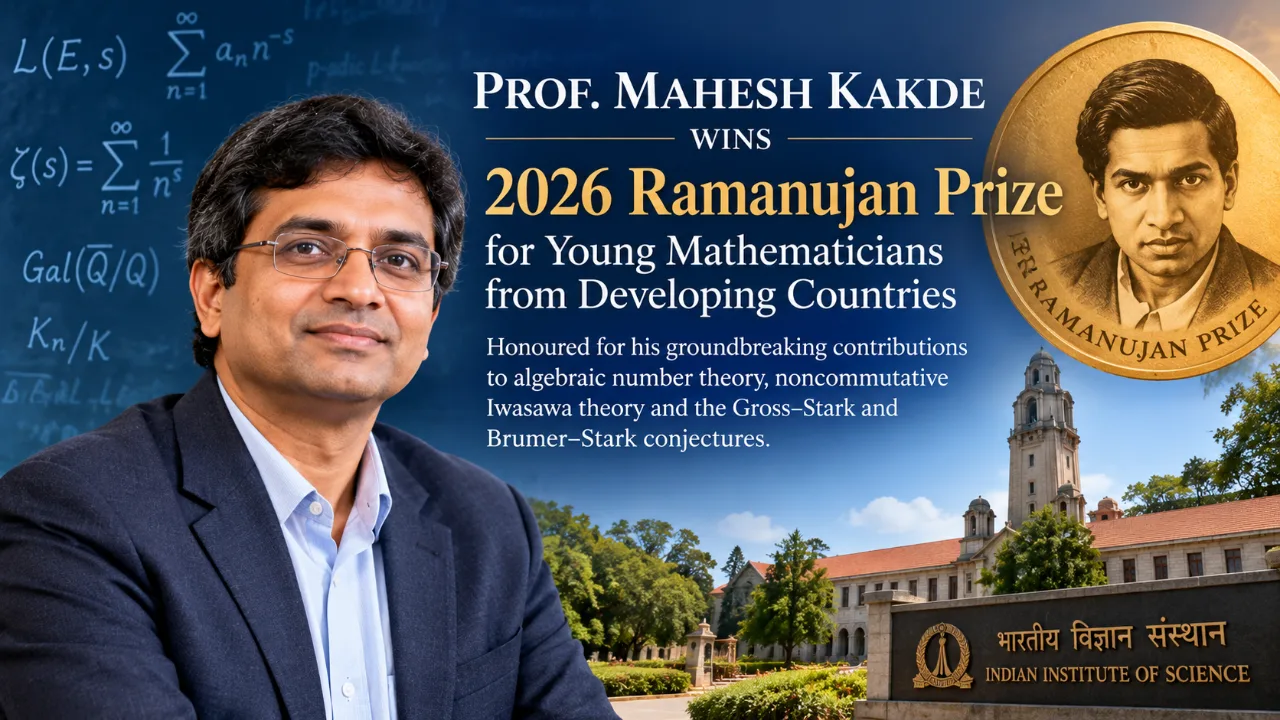
Professor Mahesh Kakde Wins 2026 Ramanujan Prize for Groundbreaking Work in Mathematics
The IISc mathematician is honoured for major contributions to algebraic number theory, including noncommutative Iwasawa theory and research on the Gross–Stark and Brumer–Stark conjectures.
BENGALURU, INDIA — Indian mathematician Professor Mahesh Kakde of the Indian Institute of Science (IISc), Bengaluru, has been awarded the prestigious 2026 Ramanujan Prize for Young Mathematicians from Developing Countries. The international recognition honours his outstanding contributions to algebraic number theory, a field that explores deep relationships between numbers, algebraic structures and mathematical equations.
The prize is administered jointly by the Abdus Salam International Centre for Theoretical Physics (ICTP) and the International Mathematical Union (IMU). Established in 2005, it recognises exceptional mathematical research conducted by young mathematicians working in developing countries.
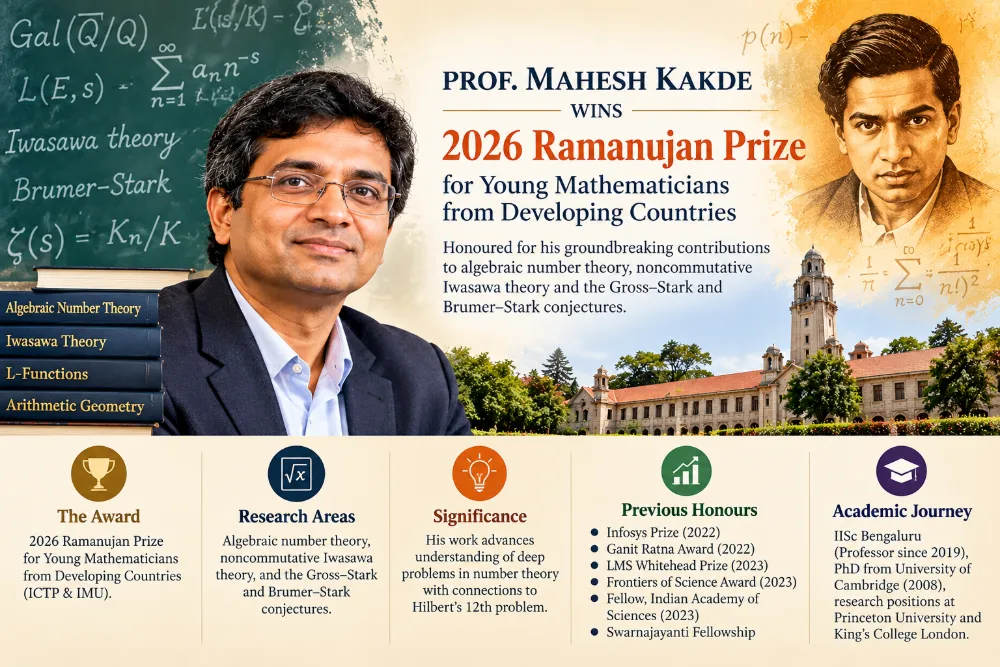
Why Did Mahesh Kakde Receive the Ramanujan Prize?
Professor Kakde was recognised for his fundamental results in noncommutative Iwasawa theory and his important work on the Gross–Stark and Brumer–Stark conjectures. These are advanced research areas concerned with the deep connections between number fields, algebraic structures and special values of mathematical functions.
His research has helped mathematicians make progress on longstanding problems in number theory. In particular, his work has implications for Hilbert’s 12th problem, one of the 23 famous mathematical problems presented by German mathematician David Hilbert in 1900.
Hilbert’s 12th problem seeks to develop a systematic understanding of certain algebraic number fields through special values of exponential and related functions. Kakde’s work addresses important aspects of this broad challenge, although the general problem remains unsolved.
What Makes His Research Important?
Algebraic number theory goes far beyond ordinary arithmetic. It investigates the structures and relationships that govern numbers, including the properties of solutions to equations and the behaviour of numbers within more complex mathematical systems.
Iwasawa theory examines how number-theoretic properties evolve across sequences of increasingly complex field extensions. Its noncommutative version extends these ideas to settings in which the underlying mathematical groups need not be commutative.
The Gross–Stark and Brumer–Stark conjectures concern relationships between special values of mathematical functions and algebraic objects associated with number fields. Progress on these problems deepens our understanding of fundamental structures in mathematics.
Kakde’s research is significant because it advances difficult theoretical questions that have occupied mathematicians for decades.
Academic Journey: From India to Leading Global Institutions
Professor Mahesh Kakde studied mathematics at the Indian Statistical Institute in Bengaluru before pursuing advanced studies at the University of Cambridge in the United Kingdom. He completed his doctorate in pure mathematics in 2008.
Following his doctoral studies, he worked at Princeton University in the United States and subsequently held academic and research positions at University College London and King's College London.
In August 2019, he joined the Indian Institute of Science, Bengaluru, where he serves as a professor in the Department of Mathematics.
His academic journey reflects the importance of sustained research, rigorous mathematical training and international collaboration in advancing fundamental science.
Previous Awards and Achievements
The 2026 Ramanujan Prize adds to Professor Kakde’s growing list of national and international honours.
- Infosys Prize in Mathematical Sciences, 2022: Recognised his contributions to algebraic number theory.
- Ganit Ratna Award, 2022: He received the inaugural award for his mathematical contributions.
- London Mathematical Society Whitehead Prize, 2023: Honoured his outstanding work in Iwasawa theory, important conjectures in number theory and advances related to Hilbert’s 12th problem.
- Frontiers of Science Award, 2023: Recognised research on the Gross–Stark conjecture, jointly authored with Samit Dasgupta and Kevin Ventullo.
- Fellow of the Indian Academy of Sciences, 2023: Another significant recognition of his scientific achievements.
- Swarnajayanti Fellowship: A prestigious Indian research fellowship supporting outstanding scientists and researchers.
He was also an invited speaker at the 2022 International Congress of Mathematicians, where he presented joint work with mathematician Samit Dasgupta on the Brumer–Stark conjecture.
Why This Achievement Matters for Indian Mathematics
Professor Kakde’s achievement highlights India's contribution to fundamental mathematical research on the global stage. While mathematics is often associated with classroom calculations and examinations, discoveries in pure mathematics emerge from years of studying abstract problems whose solutions may reshape an entire research field.
His recognition also underscores the importance of investing in universities, research institutions and young scholars who pursue difficult scientific questions without expecting immediate practical applications.
The Ramanujan Prize is therefore not merely a personal honour. It is also a reminder that Indian researchers can contribute to some of the world's most challenging intellectual pursuits.
Professor Mahesh Kakde’s 2026 Ramanujan Prize recognises years of dedicated research into some of the deepest questions in number theory. From his academic training in India and Cambridge to his work at leading international institutions and IISc Bengaluru, his career demonstrates the value of mathematical curiosity, perseverance and rigorous scholarship.
His achievement continues the tradition of Indian excellence in mathematics associated with Srinivasa Ramanujan and offers encouragement to a new generation of researchers seeking to expand the boundaries of human knowledge.
Official Editorial PDF Edition
Verified PublicationDownload a clean, high-resolution printable copy complete with tables, formulas, and high-res photography. Free for registered readers.
Community Feedback & Editorial Ratings
All Reader Reviews (0)
No reader reviews yet for this story.
Be the first to share your rating and perspective!