

Indian Art and Culture: Complete Guide to Dance, Music, Sculpture and Heritage
Explore India's classical dances, folk traditions, music systems, sculpture, architecture, paintings, literature, festivals and cultural diversity in one comprehensive guide.
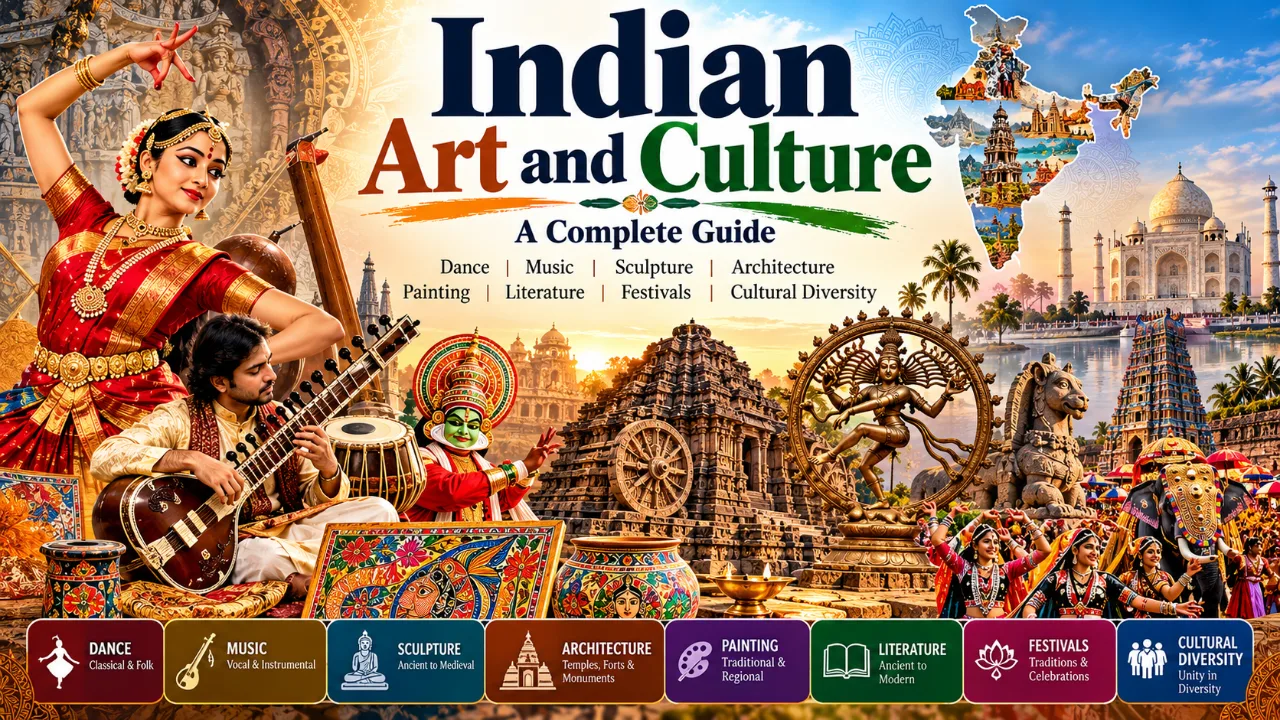
Indian Art and Culture: A Complete Guide to Dance, Music, Sculpture, Architecture and Cultural Diversity
Subtitle: A comprehensive, list-based guide to India’s classical and folk traditions, musical heritage, ancient monuments, paintings, literature, festivals and intangible cultural heritage.
Introduction: The Cultural Diversity of India
India is one of the world's most culturally diverse countries. Its artistic traditions have developed over thousands of years through religious movements, regional customs, royal patronage, trade, migration and interactions among communities.
Indian art and culture includes tangible heritage, such as monuments, sculptures, paintings and archaeological sites, as well as intangible heritage, such as music, dance, oral traditions, festivals, rituals, crafts and performing arts.
For general knowledge and competitive examination preparation, the most important approach is to connect each art form with its state or region, historical period, distinctive features, associated personalities and cultural significance.
1. Classical Dances of India
India has eight classical dance forms traditionally recognised in the framework of the Sangeet Natak Akademi.
Classical Dance | State or Region | Important Features |
|---|---|---|
Bharatanatyam | Tamil Nadu | Expressive gestures, precise footwork, temple traditions and Carnatic music |
Kathak | Northern India, especially Uttar Pradesh | Intricate footwork, spins, storytelling and rhythmic patterns |
Kathakali | Kerala | Elaborate costumes, facial expressions, colourful makeup and dance-drama |
Kuchipudi | Andhra Pradesh | Expressive storytelling, dramatic movements and traditional dance-drama |
Manipuri | Manipur | Graceful movements, devotional themes and Ras Leela traditions |
Mohiniyattam | Kerala | Soft, flowing movements and graceful expressions |
Odissi | Odisha | Sculptural poses, tribhanga posture and temple traditions |
Sattriya | Assam | Devotional dance tradition associated with Vaishnavite monasteries called Satras |
Important Facts About Classical Dance
Natya Shastra: An ancient Sanskrit treatise on performing arts traditionally attributed to Bharata Muni.
Abhinaya: The expression of emotions and meaning through facial expressions, gestures and body movements.
Mudra: A symbolic hand gesture used in dance and ritual.
Tandava: A vigorous dance traditionally associated with Shiva.
Lasya: A graceful and delicate dance concept associated with Parvati.
Chhau: A martial, folk and dance-drama tradition associated with eastern India, especially Purulia, Seraikella and Mayurbhanj.
Ras Leela: A devotional performance tradition associated with Krishna and the gopis, particularly prominent in Manipuri culture.
Important distinction: Chhau is a major Indian dance tradition and has UNESCO intangible cultural heritage recognition, but it is not one of the eight classical dance forms listed above.
2. Major Folk and Regional Dances
Folk dances reflect local livelihoods, seasonal changes, agricultural cycles, religious beliefs, community celebrations and tribal traditions.
Dance Form | State or Region |
|---|---|
Bihu | Assam |
Garba | Gujarat |
Dandiya Raas | Gujarat |
Ghoomar | Rajasthan |
Kalbelia | Rajasthan |
Giddha | Punjab |
Bhangra | Punjab |
Lavani | Maharashtra |
Koli | Maharashtra |
Rouf | Jammu and Kashmir |
Nati | Himachal Pradesh |
Chholiya | Uttarakhand |
Panthi | Chhattisgarh |
Karma | Central and eastern Indian tribal regions |
Cheraw (Bamboo Dance) | Mizoram |
Hojagiri | Tripura |
Dollu Kunitha | Karnataka |
Theyyam | Kerala |
Thiruvathirakali | Kerala |
Perini Shivatandavam | Telangana |
Dhimsa | Andhra Pradesh and adjoining tribal regions |
Ghumura | Odisha |
Purulia Chhau | West Bengal |
Seraikella Chhau | Jharkhand |
Mayurbhanj Chhau | Odisha |
Study tip: Remember the difference between classical dance, folk dance, ritual performance and martial dance. A dance may combine several of these features.
3. Indian Classical Music
Indian classical music has two major traditions: Hindustani music and Carnatic music.
A. Hindustani Classical Music
Main region: Northern India.
Important forms: Dhrupad, Khayal, Tarana and Thumri.
Dhrupad: One of the oldest surviving forms of Hindustani classical vocal music.
Khayal: A major vocal form that allows extensive melodic improvisation.
Thumri: A semi-classical form often associated with romantic and devotional expression.
Dadra: A light-classical vocal form.
B. Carnatic Classical Music
Main region: Southern India.
Important features: Compositions, melodic improvisation and rhythmic complexity.
Trinity of Carnatic Music:
Tyagaraja
Muthuswami Dikshitar
Syama Sastri
Important Music Concepts
Raga: A melodic framework that provides the basis for musical expression.
Tala: A rhythmic cycle.
Shruti: A concept related to musical pitch and subtle tonal intervals.
Alap: An introductory exploration of a raga.
Gharana: A lineage or school of musical performance and teaching.
Jugalbandi: A musical performance featuring two soloists or instrumental traditions in dialogue.
4. Important Indian Musical Instruments
Instrument | Type | Important Association |
|---|---|---|
Sitar | String | Hindustani classical music |
Sarod | String | Hindustani classical music |
Veena | String | Indian classical traditions, especially Carnatic music |
Santoor | Struck string | Kashmir and Hindustani music |
Sarangi | Bowed string | Hindustani classical and folk music |
Tabla | Percussion | Hindustani classical music |
Mridangam | Percussion | Carnatic classical music |
Pakhawaj | Barrel drum | Dhrupad and traditional percussion |
Ghatam | Percussion | Carnatic music |
Bansuri | Wind | Bamboo flute traditions |
Shehnai | Wind | Ceremonial and classical music |
Nadaswaram | Wind | South Indian temple and ceremonial music |
Ektara | String | Baul and other folk traditions |
Rabab | String | Regional and classical traditions |
Dhol | Percussion | Numerous folk traditions across India |
Important Vocal and Folk Traditions
Baul: A distinctive musical and spiritual tradition of Bengal.
Qawwali: A devotional musical tradition associated with Sufi gatherings.
Abhang: Devotional songs associated with the Varkari tradition of Maharashtra.
Borgeet: Devotional songs associated with the Vaishnavite tradition of Assam.
Pandavani: A narrative singing tradition associated with the Mahabharata, particularly Chhattisgarh.
Lavani songs: Musical performances closely associated with Maharashtra's Lavani tradition.
5. Indian Sculpture: From the Indus Valley to the Medieval Period
Indian sculpture developed through diverse materials, artistic styles, religious traditions and regional schools.
A. Indus Valley Civilisation
Period: Approximately 2600–1900 BCE for the Mature Harappan phase.
Important examples: Bronze Dancing Girl from Mohenjo-daro, the so-called Priest-King figure and terracotta figurines.
Materials: Bronze, stone, terracotta and other materials.
Significance: Demonstrates advanced craftsmanship and urban artistic traditions.
B. Mauryan Sculpture
Period: Approximately 4th–2nd centuries BCE.
Important features: Monumental stone pillars, polished stone surfaces and animal capitals.
Famous example: Lion Capital of Ashoka at Sarnath.
Importance: The Lion Capital became the basis of India's State Emblem.
C. Gandhara School
Region: Northwestern parts of the Indian subcontinent.
Features: Greco-Roman artistic influences combined with Buddhist themes.
Important contribution: Early anthropomorphic representations of the Buddha.
D. Mathura School
Region: Mathura and surrounding areas.
Features: Indigenous Indian artistic traditions and distinctive sculptural treatment of religious figures.
Subjects: Buddhist, Jain and Hindu imagery.
E. Amaravati School
Region: Lower Krishna Valley, especially present-day Andhra Pradesh.
Features: Intricate relief carvings and Buddhist narrative art.
Important association: Stupa architecture and Buddhist storytelling.
F. Gupta Sculpture
Period: Approximately 4th–6th centuries CE.
Features: Refined proportions, spiritual expression, balance and graceful forms.
Importance: Frequently regarded as a major phase in the development of classical Indian sculpture.
G. Chola Bronze Sculpture
Region: Tamil Nadu.
Period: Particularly prominent during the medieval Chola period.
Famous example: Nataraja, the dancing form of Shiva.
Features: Lost-wax casting, dynamic movement and sophisticated bronze craftsmanship.
Key comparison: Gandhara is noted for Greco-Roman influences, Mathura for indigenous sculptural traditions, Amaravati for Buddhist reliefs and Chola art for celebrated bronze images.
6. Indian Architecture: Major Styles and Monuments
A. Ancient Architecture
Harappan architecture: Planned cities, drainage systems, wells and carefully organised urban settlements.
Buddhist architecture: Stupas, chaityas and viharas.
Sanchi Stupa: A major Buddhist monument in Madhya Pradesh.
Ajanta Caves: Famous for Buddhist paintings, sculptures and rock-cut architecture.
Ellora Caves: A remarkable complex representing Buddhist, Hindu and Jain traditions.
Karla Caves: Known for their Buddhist chaitya hall.
B. Temple Architecture
Style | Major Region | Key Features |
|---|---|---|
Nagara | Northern India | Curvilinear shikhara over the sanctum |
Dravida | Southern India | Towering vimana over the sanctum and monumental temple complexes |
Vesara | Deccan region | Features associated with northern and southern temple traditions |
Important Temples
Brihadisvara Temple: Thanjavur, Tamil Nadu; associated with Chola architecture.
Sun Temple: Konark, Odisha; designed in the form of a monumental chariot of the Sun God.
Khajuraho Temples: Madhya Pradesh; known for elaborate sculptural decoration.
Meenakshi Temple: Madurai, Tamil Nadu; famous for its gopurams.
Kailasa Temple: Ellora, Maharashtra; a monumental rock-cut temple.
Hoysaleswara Temple: Halebidu, Karnataka; noted for intricate sculptural work.
C. Indo-Islamic and Mughal Architecture
Qutb Minar: Delhi; associated with the early Delhi Sultanate period.
Alai Darwaza: Delhi; an important example of Sultanate architecture.
Humayun's Tomb: Delhi; an important precursor to later Mughal garden-tomb architecture.
Fatehpur Sikri: Uttar Pradesh; associated with Emperor Akbar.
Taj Mahal: Agra, Uttar Pradesh; commissioned by Shah Jahan.
Red Fort: Delhi; a major Mughal imperial complex.
Gol Gumbaz: Vijayapura, Karnataka; famous for its monumental dome and acoustics.
Charminar: Hyderabad, Telangana; a landmark of Deccan architecture.
D. Colonial and Modern Architecture
Victoria Memorial: Kolkata; a major monument of the British colonial period.
Gateway of India: Mumbai; built during the colonial era.
India Gate: New Delhi; a war memorial.
Rashtrapati Bhavan: New Delhi; an important example of imperial-era architecture adapted for independent India.
Chandigarh: Known for modernist urban planning and architecture, including works associated with Le Corbusier.
7. Indian Painting Traditions
Indian painting includes prehistoric rock art, murals, miniature paintings, manuscript illustrations and vibrant regional folk traditions.
Painting Tradition | State or Region | Important Features |
|---|---|---|
Ajanta murals | Maharashtra | Buddhist themes and narrative paintings |
Mughal miniature | Mughal courts | Court scenes, portraits, battles and natural history |
Rajput painting | Rajasthan and adjoining regions | Courtly, devotional and literary themes |
Pahari painting | Himalayan hill states | Krishna themes, lyrical landscapes and fine detail |
Madhubani | Bihar | Geometric patterns, ritual themes and bold colours |
Warli | Maharashtra | Geometric human figures and community life |
Pattachitra | Odisha and parts of West Bengal | Traditional narrative painting on cloth or other prepared surfaces |
Kalamkari | Andhra Pradesh and Telangana traditions | Hand-painted or block-printed textile art |
Phad | Rajasthan | Narrative scroll paintings |
Gond art | Central Indian tribal communities | Pattern-rich imagery inspired by nature and community beliefs |
Kalighat painting | Bengal | Bold, stylised paintings associated with 19th-century Kolkata |
Pithora | Tribal communities of Gujarat and Madhya Pradesh | Ritual wall paintings |
Cheriyal scroll painting | Telangana | Narrative scrolls associated with storytelling traditions |
Important Distinctions
Madhubani: Associated particularly with the Mithila region of Bihar.
Warli: Known for geometric figures and depictions of everyday community life.
Kalamkari: A textile-art tradition involving painting and/or block printing.
Pattachitra: A traditional painted narrative art associated especially with Odisha and also found in Bengal in distinct regional forms.
Mughal miniature: Strongly associated with court patronage, portraiture and illustrated manuscripts.
8. Indian Literature and Literary Heritage
India has a long literary history spanning oral traditions, ancient texts, classical Sanskrit works, regional literatures and modern writing.
Ancient Texts
Rigveda: The oldest of the four Vedas.
Samaveda: Closely associated with chants and musical recitation.
Yajurveda: Associated with sacrificial formulas and ritual procedures.
Atharvaveda: Contains hymns, prayers and material relating to everyday life and ritual traditions.
Upanishads: Philosophical texts exploring concepts such as the self, ultimate reality and knowledge.
Ramayana: Traditionally attributed to Valmiki.
Mahabharata: Traditionally attributed to Vyasa.
Arthashastra: Traditionally associated with Kautilya.
Ashtadhyayi: The Sanskrit grammatical work of Panini.
Classical Sanskrit Literature
Kalidasa: Associated with works such as Abhijnanashakuntalam, Meghaduta and Raghuvamsha.
Bhasa: An important Sanskrit dramatist.
Banabhatta: Associated with Harshacharita and Kadambari.
Dandin: Associated with Dashakumaracharita.
Bharavi: Known for Kiratarjuniya.
Magha: Known for Shishupalavadha.
Bhakti and Sufi Literary Traditions
Kabir: Known for devotional verses challenging social and religious divisions.
Tulsidas: Associated with Ramcharitmanas.
Surdas: Associated with Krishna devotional poetry.
Mirabai: Known for devotional poetry dedicated to Krishna.
Guru Nanak: Founder of Sikhism and a major figure in the Bhakti-era devotional landscape.
Amir Khusrau: Associated with Indo-Persian literary and musical traditions.
Chaitanya Mahaprabhu: A major figure in Bengal's Vaishnavite devotional movement.
Regional Literature
Regional languages have played a central role in preserving local history, social memory, philosophical ideas and cultural identity. Important literary traditions include Bengali, Tamil, Telugu, Kannada, Malayalam, Marathi, Assamese, Odia, Punjabi, Kashmiri, Urdu and many tribal and other community languages.
9. Indian Theatre, Puppetry and Storytelling
Traditional performance arts often combine music, movement, costume, dialogue, ritual and narrative.
Yakshagana: Karnataka; a dance-drama tradition.
Kutiyattam: Kerala; a classical Sanskrit theatre tradition recognised by UNESCO.
Koodiyattam: Another common spelling of Kutiyattam.
Ankiya Naat: Assam; associated with the Vaishnavite tradition of Sankardev.
Jatra: Popular theatrical tradition of Bengal and eastern India.
Nautanki: North Indian folk theatre.
Tamasha: Maharashtra; a traditional folk theatre form.
Bhavai: Gujarat; a folk theatre tradition.
Therukoothu: Tamil Nadu; a traditional street theatre form.
Ramlila: Dramatic enactments of the Ramayana.
Kathputli: Rajasthan; a traditional string-puppet tradition.
Tholu Bommalata: Andhra Pradesh; shadow puppetry.
Togalu Gombeyata: Karnataka; shadow puppetry.
Putul Nach: Bengal; a traditional puppetry tradition.
Remember: Kutiyattam, Ramlila and several other living performance traditions have been recognised internationally as important intangible cultural heritage.
10. Indian Handicrafts, Textiles and Traditional Arts
Craft or Textile | State or Region |
|---|---|
Banarasi silk | Uttar Pradesh |
Kanchipuram silk | Tamil Nadu |
Patola | Gujarat |
Bandhani | Gujarat and Rajasthan |
Chikankari | Lucknow, Uttar Pradesh |
Phulkari | Punjab |
Pashmina | Kashmir |
Kullu shawls | Himachal Pradesh |
Blue pottery | Rajasthan, especially Jaipur |
Bidriware | Bidar, Karnataka |
Dhokra metal craft | Several regions, including West Bengal and Chhattisgarh |
Channapatna toys | Karnataka |
Kondapalli toys | Andhra Pradesh |
Saharanpur wood carving | Uttar Pradesh |
Kantha embroidery | Bengal |
Baluchari silk | West Bengal |
Pattachitra | Odisha and Bengal, in distinct regional forms |
Bamboo and cane crafts | Northeastern India and other regions |
These traditions reflect local resources, specialised skills, hereditary knowledge, community identity and long-distance trade.
11. Festivals and Cultural Diversity Across India
Indian festivals express religious beliefs, agricultural cycles, seasonal changes, historical memories and community traditions.
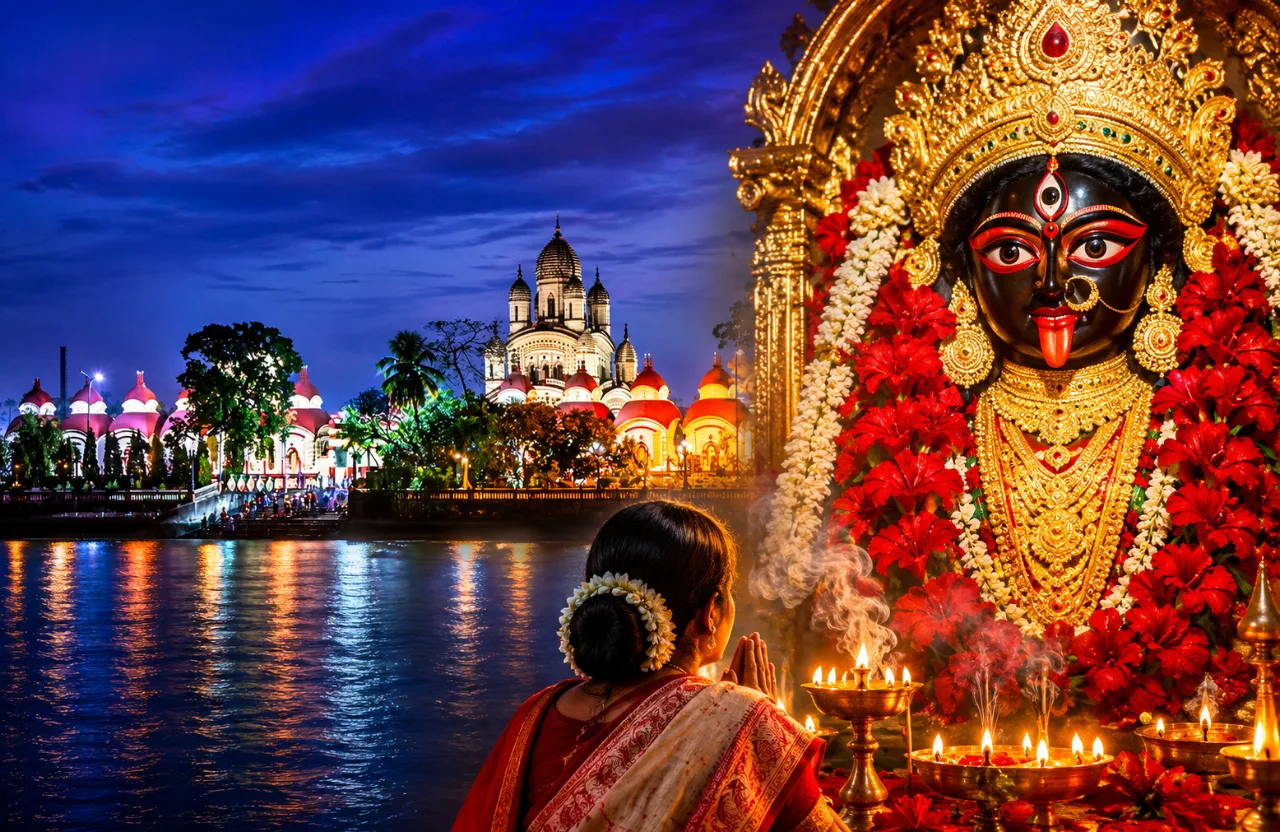
Durga Puja: Especially prominent in West Bengal; celebrates the goddess Durga.
Bihu: Assam; linked to agricultural seasons and Assamese cultural identity.
Pongal: Tamil Nadu; a harvest festival.
Onam: Kerala; a major cultural festival associated with the Mahabali legend and harvest traditions.
Vishu: Kerala; marks the traditional Malayalam New Year period.
Lohri: Punjab and neighbouring regions; associated with winter and harvest traditions.
Baisakhi: Punjab; a harvest festival with major significance in Sikh history.
Navratri: Celebrated in many regions with different forms of worship and performance.
Ganesh Chaturthi: Especially prominent in Maharashtra.
Rath Yatra: Particularly famous in Puri, Odisha.
Hornbill Festival: Nagaland; showcases the cultural traditions of Naga communities.
Losar: Celebrated by several Himalayan Buddhist communities, with regional variations.
Chhath Puja: Particularly prominent in Bihar, Jharkhand and eastern Uttar Pradesh.
Thrissur Pooram: Kerala; famous for temple-centred festivities and percussion traditions.
Hemis Festival: Ladakh; associated with Tibetan Buddhist traditions.
Cultural principle: Similar festivals may have different names, rituals and meanings across regions. India's diversity is best understood through both shared themes and local variations.
12. UNESCO and India's Intangible Cultural Heritage
Intangible cultural heritage consists of living traditions, skills, performances, rituals, knowledge and community practices transmitted across generations.
Important examples associated with India include:
Kutiyattam, Sanskrit theatre.
Ramlila, the traditional performance of the Ramayana.
Chhau dance.
Kalbelia folk songs and dances of Rajasthan.
Mudiyettu, a ritual theatre and dance tradition of Kerala.
Buddhist chanting of Ladakh.
Sankirtana, ritual singing, drumming and dancing in Manipur.
Yoga.
Durga Puja in Kolkata.
Garba of Gujarat.
UNESCO recognition helps increase awareness and supports safeguarding efforts. It does not mean that every important Indian art form has been inscribed on UNESCO's list.
For updated and complete information, consult the official Sangeet Natak Akademi Intangible Cultural Heritage list and the Ministry of Culture.
13. Important Cultural Institutions of India
Institution | Main Area of Work |
|---|---|
Sangeet Natak Akademi | Performing arts, including music, dance and drama |
Sahitya Akademi | Indian literature and literary recognition |
Lalit Kala Akademi | Visual arts |
Archaeological Survey of India (ASI) | Archaeological research and protection of monuments |
National Gallery of Modern Art (NGMA) | Modern and contemporary Indian art |
National School of Drama (NSD) | Theatre education and performance |
Indira Gandhi National Centre for the Arts (IGNCA) | Research and documentation of arts and cultural heritage |
Indian Council for Cultural Relations (ICCR) | International cultural exchange |
Important fact: Sangeet Natak Akademi was established in 1953 as India's national academy for music, dance and drama.
14. Frequently Confused Art and Culture Facts
Hindustani vs Carnatic music: Hindustani is mainly associated with northern India; Carnatic is mainly associated with southern India.
Nagara vs Dravida architecture: Nagara is primarily associated with northern India; Dravida with southern India.
Gandhara vs Mathura sculpture: Gandhara displays Greco-Roman influences; Mathura is noted for indigenous sculptural traditions.
Bharatanatyam vs Kathak: Bharatanatyam is associated with Tamil Nadu; Kathak developed primarily in northern India.
Kutiyattam vs Kathakali: Both are associated with Kerala, but they are distinct performance traditions.
Madhubani vs Warli: Madhubani is associated with the Mithila region; Warli is associated with tribal communities of western India.
Baul vs Borgeet: Baul is associated with Bengal; Borgeet with Assam.
Nataraja: A celebrated representation of Shiva as the cosmic dancer, particularly associated with Chola bronze sculpture.
Lion Capital of Ashoka: The original is at Sarnath; the adapted Lion Capital is India's State Emblem.
Classical vs folk art: Classical forms generally have codified traditions and formal training systems, while folk forms are often closely tied to local community practices. The boundaries can overlap.
15. Quick Revision List
Before completing a revision session, make sure you can recall:
The eight classical dance forms and their associated regions.
The difference between Hindustani and Carnatic music.
Major musical instruments and their classifications.
The Gandhara, Mathura and Amaravati schools of sculpture.
The major features of Nagara, Dravida and Vesara architecture.
Important monuments and the dynasties or periods associated with them.
Major Indian painting traditions and their regions.
The authors and works of major ancient and classical texts.
Folk theatre, puppetry and storytelling traditions.
Traditional textiles, handicrafts and their regional associations.
Important festivals and their cultural significance.
The roles of Sangeet Natak Akademi, Sahitya Akademi, Lalit Kala Akademi and ASI.
UNESCO-recognised Indian intangible cultural heritage traditions.
Conclusion
Indian art and culture is not a single uniform tradition. It is a living network of classical disciplines, folk expressions, tribal knowledge, religious practices, regional languages, architecture, crafts and artistic innovation.
Understanding the relationship between an art form and its region, history, technique and cultural context makes revision more effective than memorising isolated facts. A systematic study of these traditions provides a strong foundation for general knowledge, cultural awareness and broader understanding of India's civilisational diversity.
Official Editorial PDF Edition
Verified PublicationDownload a clean, high-resolution printable copy complete with tables, formulas, and high-res photography. Free for registered readers.
Community Feedback & Editorial Ratings
All Reader Reviews (0)
No reader reviews yet for this story.
Be the first to share your rating and perspective!