







India’s Trade Deficit Widens to $30.21 Billion: Can New Trade Deals Boost Exports?
India’s September 2026 trade figures highlight the challenge of rising imports, export competitiveness and global uncertainty as new trade agreements create opportunities for Indian businesses.
India’s Trade Deficit Widens to $30.21 Billion: Can New Trade Deals Boost Exports?
NEW DELHI, October 19, 2026: India’s international trade is facing a critical test as the country seeks to expand exports, manage rising imports and navigate an increasingly uncertain global trading environment.
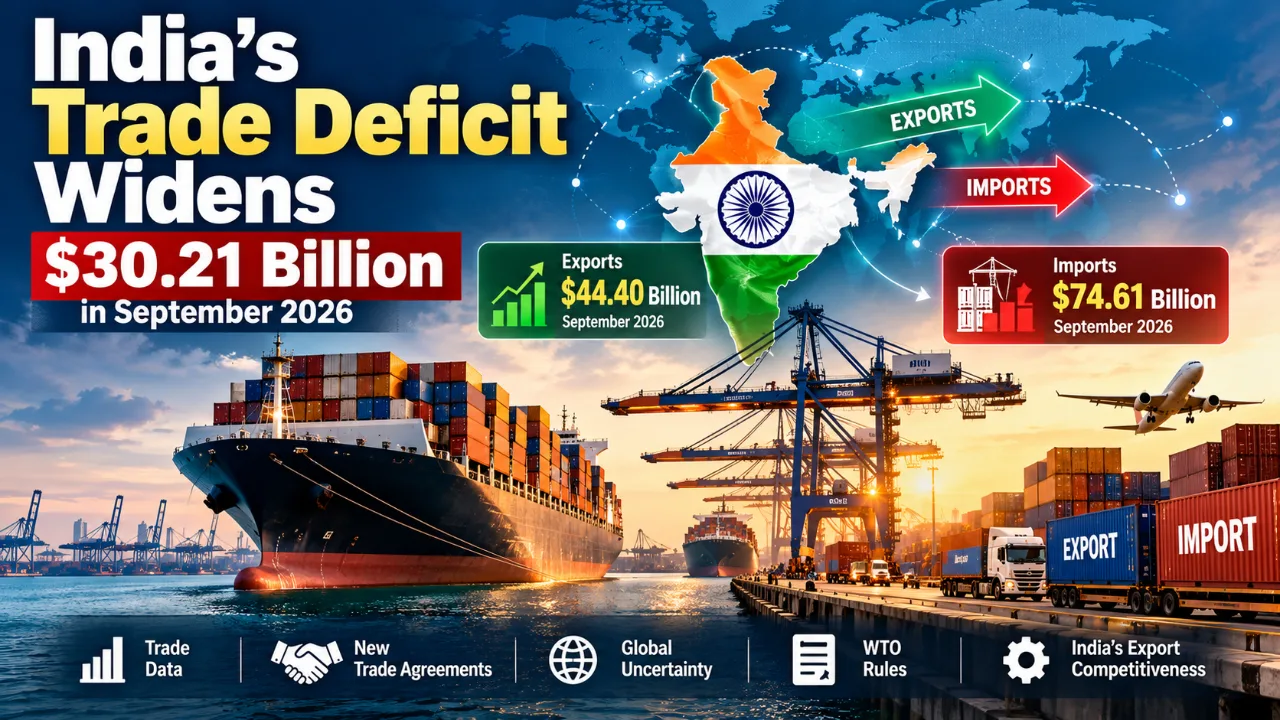
India’s merchandise trade deficit widened to $30.21 billion in September 2026, compared with $26.86 billion in August, according to figures reported by Reuters on October 15. Merchandise imports increased to $74.61 billion, while exports reached $44.40 billion.
The figures highlight the challenge of ensuring that export growth keeps pace with import demand. At the same time, India is pursuing trade agreements with key partners, including New Zealand, the United Kingdom, the European Union and the United States, to improve market access and diversify trade relationships.
The issue is significant for India's economic growth, foreign exchange management, industrial development and global economic position.
1. Why Is India’s Trade Deficit in the News?
India’s merchandise trade deficit increased in September 2026 because the value of imported goods rose more sharply than the value of exported goods.
According to the latest reported figures:
Indicator | September 2026 |
|---|---|
Merchandise exports | $44.40 billion |
Merchandise imports | $74.61 billion |
Merchandise trade deficit | $30.21 billion |
Merchandise trade deficit in August 2026 | $26.86 billion |
Source: Reuters, October 15, 2026.
The merchandise trade deficit is calculated by subtracting the value of merchandise exports from merchandise imports.
A deficit does not automatically indicate economic weakness. Imports may include crude oil, machinery, electronic components, industrial inputs and capital goods that support domestic production and future exports.
The important question is whether imports are generating productive capacity and economic value, and whether exports can grow sustainably over time.
2. What Is the Difference Between Trade Deficit and Current Account Deficit?
These two concepts are related but are not interchangeable.
Trade Deficit
A merchandise trade deficit occurs when the value of imported goods exceeds the value of exported goods during a given period.
For example, if a country imports goods worth $100 billion and exports goods worth $70 billion, its merchandise trade deficit is $30 billion.
Current Account Deficit
The current account is broader. It includes:
Trade in goods
Trade in services
Primary income, such as investment income
Secondary income, including transfers and remittances
A country may have a merchandise trade deficit but a smaller current account deficit because it earns substantial revenue from services exports and receives remittances from abroad.
India's IT services exports and inward remittances are important components of this broader external-sector picture.
3. India’s External Trade: The Wider Picture
The September figures form part of a larger trend in India's external trade.
Reuters reported that during April–September 2026, India's combined goods and services exports reached $476.20 billion, representing year-on-year growth of 13.84%. Imports rose by 15.68% to $551.13 billion.
The figures indicate that both exports and imports are expanding, but imports are growing faster in the reported period.
This difference matters because sustained growth in exports can support employment, manufacturing, foreign exchange earnings and economic resilience. At the same time, imports of energy, technology, machinery and essential production inputs may be necessary for economic expansion.
The policy challenge is not simply to reduce imports. It is to strengthen India's ability to produce competitively, increase the value added in exports and reduce avoidable external vulnerabilities.
4. What Is Driving India’s Trade Challenge?
Several structural and international factors influence India's trade balance.
A. Dependence on Imported Energy
India imports a substantial proportion of the crude oil it consumes. Higher international energy prices can increase the import bill even when the physical volume of imports changes relatively little.
Energy imports affect transport costs, industrial production, inflation and the demand for foreign currency.
Geopolitical tensions affecting shipping routes or energy supplies can therefore influence India's trade balance.
B. Electronics and Capital Goods
Imports of electronic components, advanced machinery and other capital goods may rise when domestic industries expand or invest in new technology.
Such imports can be economically beneficial if they improve productivity, create domestic manufacturing capacity and support future exports.
However, dependence on imported components can leave manufacturers vulnerable to global supply disruptions.
C. Export Competitiveness
Indian exporters face competition in price, quality, delivery times, logistics, standards compliance and access to international distribution networks.
High logistics costs, limited scale, complex compliance requirements and inconsistent access to finance can make it difficult for smaller firms to compete globally.
Improving productivity and reliability is therefore essential for converting trade agreements into actual export growth.
D. Global Geopolitical Uncertainty
International conflicts can affect energy markets, shipping costs, insurance premiums and supply chains.
The World Trade Organization's October 2026 outlook noted that global merchandise trade had proved more resilient than expected, partly because of strong demand for AI-related products. Nevertheless, the effects of conflict in the Middle East remained uneven across goods, services and regions.
These developments demonstrate how international trade is shaped by both domestic competitiveness and external shocks.
5. India–New Zealand FTA: A New Opportunity for Trade
India's trade strategy increasingly involves negotiating agreements that improve access to foreign markets while addressing the needs of domestic industries.
On October 19, 2026, the Economic Times reported that India had notified the first phase of customs-duty reductions for selected imports from New Zealand under their bilateral Free Trade Agreement. The first reductions are scheduled to take effect on October 20, 2026.
The agreement is intended to facilitate trade between the two economies by providing agreed tariff concessions and improving market access.
What Is a Free Trade Agreement?
A Free Trade Agreement, or FTA, is an agreement between two or more economies to reduce or remove specified trade barriers on agreed products and, in many cases, services and other economic activities.
FTAs may cover:
Customs duties and tariff concessions
Rules of origin
Customs procedures and trade facilitation
Services and investment
Intellectual property
Standards and regulatory cooperation
Dispute settlement
The actual coverage differs between agreements. An FTA does not necessarily eliminate every tariff or restriction on every product.
Why Do Rules of Origin Matter?
Rules of origin determine whether a product qualifies for preferential treatment under an FTA.
Without these rules, goods from a third country could potentially enter the country with the lowest external tariff and then be re-exported to another partner to exploit preferential rates.
Rules of origin help ensure that tariff benefits apply to eligible goods according to the agreement's requirements.
Potential Benefits for India
Trade agreements can create opportunities for Indian businesses to expand exports, diversify markets, access technology and participate in international supply chains.
However, the benefits depend on whether Indian firms can meet foreign standards, compete on quality and price, and navigate the agreement's rules.
Lower tariffs on imports can also benefit consumers and manufacturers that depend on imported inputs, although they may increase competitive pressure on some domestic producers.
6. India’s Broader Trade Strategy
India is pursuing a combination of bilateral and regional trade initiatives to expand market access and strengthen economic relationships.
India–United Kingdom
The India–UK trade agreement is part of efforts to deepen economic engagement with a major developed economy. Its practical effects depend on implementation, product-specific tariff schedules and the ability of businesses to use the available preferences.
India–European Union
Trade negotiations with the European Union are important because the EU represents a large market for manufactured goods, services and higher-value products.
Potential gains must be assessed alongside differences in product standards, sustainability requirements, regulatory compliance and market-access conditions.
India–United States
India–US trade discussions remain important because the United States is a major destination for Indian exports, including pharmaceuticals, engineering products, textiles and services.
Tariff uncertainty and differences over market access can influence business decisions and investment planning.
India–New Zealand
The initial tariff reductions under the India–New Zealand agreement represent a practical example of how negotiated trade commitments move into implementation.
The wider impact will depend on the products covered, the depth of concessions, the response of businesses and changes in bilateral trade flows.
7. What Does the WTO Say About Global Trade?
The World Trade Organization provides the principal multilateral framework for international trade rules.
In its October 8, 2026, update, the WTO raised its forecast for global merchandise trade volume growth in 2026 to 3.9%, compared with its March forecast of 1.9%.
The revised outlook reflected stronger-than-expected trade in the first half of the year and rapid growth in AI-related products.
The WTO reported that trade in AI-enabling goods, including semiconductors and servers, increased by 67% year-on-year in the first half of 2026. These products accounted for 47% of global merchandise trade growth during that period.
The WTO also lowered its forecast for commercial services trade volume growth in 2026 to 3.3%, from the March forecast of 4.8%, reflecting pressures on transport and travel services associated with the Middle East conflict.
These projections are forecasts, not final annual results.
Why Is AI Affecting International Trade?
Artificial intelligence requires data centres, servers, semiconductors, networking equipment, electricity infrastructure and cooling systems.
The expansion of AI infrastructure has therefore increased demand for specific technology-related products traded across international borders.
This illustrates how technological change can reshape trade patterns, create new export opportunities and influence the geographical distribution of manufacturing and investment.
For India, the opportunity lies not only in importing advanced equipment but also in strengthening electronics manufacturing, semiconductor-related capabilities, digital services and high-value exports.
8. International Trade: Important Static Concepts
Comparative Advantage
The principle of comparative advantage, associated with economist David Ricardo, explains why countries can benefit from specialisation and trade even when one country is more productive in producing all goods.
The key is relative opportunity cost.
A country benefits when it specialises in activities where its opportunity cost is comparatively lower and trades for other goods and services.
In practice, transport costs, technology, skills, trade barriers and market conditions influence the extent to which these theoretical gains can be realised.
Tariffs and Non-Tariff Barriers
A tariff is a customs duty imposed on imported or exported goods, although import tariffs are the most common form relevant to modern trade policy.
Non-tariff measures include quotas, licensing requirements, technical standards, sanitary and phytosanitary rules, and other regulatory measures that affect trade.
Some non-tariff measures serve legitimate purposes, such as protecting public health or ensuring product safety. Problems arise when measures are unnecessarily restrictive, discriminatory or inconsistent with applicable trade commitments.
Most-Favoured-Nation Principle
Under the WTO's Most-Favoured-Nation principle, a member generally cannot discriminate between trading partners in the treatment covered by the relevant rules.
However, WTO law recognises specified exceptions, including qualifying free trade agreements and customs unions under applicable conditions.
National Treatment
The National Treatment principle generally requires imported products to receive treatment no less favourable than like domestic products once they have entered the market, subject to the relevant WTO rules.
It is distinct from the Most-Favoured-Nation principle, which concerns treatment between foreign trading partners.
Trade Facilitation
Trade facilitation refers to simplifying, modernising and harmonising import and export procedures.
Efficient customs systems, digital documentation, transparent procedures and reliable logistics can reduce costs and delays, particularly for small and medium-sized exporters.
The WTO Trade Facilitation Agreement entered into force on February 22, 2017.
9. The WTO and International Trade Agreements
The WTO was established on January 1, 1995, following the Uruguay Round of trade negotiations.
It provides a framework for trade negotiations, monitoring members' trade policies and resolving disputes under its agreements.
Important WTO agreements include:
General Agreement on Tariffs and Trade (GATT): Governs important aspects of international trade in goods.
General Agreement on Trade in Services (GATS): Establishes rules for international trade in services.
Agreement on Trade-Related Aspects of Intellectual Property Rights (TRIPS): Sets minimum standards for intellectual property protection within the WTO framework.
Agreement on Trade Facilitation (TFA): Seeks to simplify customs procedures and facilitate the movement, release and clearance of goods.
Agreement on Agriculture (AoA): Establishes disciplines relating to agricultural market access, domestic support and export competition, subject to the agreement's provisions.
These frameworks matter because countries must consider both their bilateral commitments and their wider obligations under the multilateral trading system.
10. What Should India Do to Improve Export Performance?
A sustainable export strategy requires more than signing trade agreements.
Improve Logistics and Infrastructure
Reliable ports, roads, railways, warehousing and digital customs systems can reduce delivery times and improve export competitiveness.
Diversify Export Markets
Greater access to multiple markets can reduce dependence on a small number of destinations and make exporters more resilient to policy changes.
Increase Value Addition
India can improve export earnings by expanding higher-value manufacturing, advanced engineering, electronics, pharmaceuticals, food processing and specialised services.
Support MSME Exporters
Small businesses often face difficulties with finance, certification, market information and compliance. Better access to export credit, digital platforms, trade information and testing facilities can help them enter international markets.
Strengthen Standards and Quality
Compliance with international standards is essential for entering many high-value markets. Quality infrastructure, testing laboratories and technical assistance can help firms meet those requirements.
Reduce Unnecessary Import Vulnerabilities
Developing competitive domestic capabilities in selected strategic sectors can improve resilience. However, import substitution should be assessed carefully because imported technology and intermediate goods can also increase productivity.
Improve the Use of FTAs
Businesses need clear information about tariff preferences, rules of origin, product standards and customs procedures.
The success of an agreement should be measured not only by the tariff concessions negotiated but also by actual utilisation, export growth, investment and benefits to domestic producers and consumers.
11. What Are the Risks of Protectionism?
Protectionism refers to policies that shield domestic producers from foreign competition, often through tariffs, quotas or other restrictions.
Some temporary or targeted interventions may be used for legitimate policy objectives, but excessive protection can have costs.
Higher import barriers may increase the cost of inputs, reduce competition and raise prices for consumers. Trading partners may respond with retaliatory measures, affecting exporters.
At the same time, governments must consider legitimate concerns involving national security, supply-chain resilience, unfair trade practices and strategic industries within the boundaries of applicable law.
The challenge is to balance domestic economic priorities with the benefits of predictable, rules-based international trade.
12. Conclusion: Can Trade Agreements Narrow India’s Trade Deficit?
India's widening merchandise trade deficit in September 2026 highlights the complexity of managing an economy that imports energy, technology and industrial inputs while seeking to expand exports.
New trade agreements can create opportunities by reducing specified trade barriers and improving access to international markets. However, their effectiveness depends on domestic productivity, logistics, quality standards, skills, finance and the ability of firms to meet foreign demand.
A trade deficit is not inherently harmful, just as a trade surplus is not automatically evidence of economic strength. The composition of trade, the use of imported resources, export competitiveness and the broader current account position all matter.
For India, the long-term objective should be to build a competitive, diversified and resilient export economy while maintaining access to essential imports and participating effectively in the rules-based multilateral trading system.
Topic | Key Fact |
|---|---|
September 2026 merchandise trade deficit | $30.21 billion |
September 2026 merchandise exports | $44.40 billion |
September 2026 merchandise imports | $74.61 billion |
WTO established | January 1, 1995 |
GATT | Framework for trade in goods |
GATS | Framework for trade in services |
TRIPS | Trade-related intellectual property rules |
WTO Trade Facilitation Agreement | Entered into force on February 22, 2017 |
Comparative advantage | Specialisation based on relative opportunity costs |
Current account | Includes goods, services, primary income and secondary income |
FTA | Preferential trade agreement among eligible parties, subject to its t5erms and applicable rules |
Official Editorial PDF Edition
Verified PublicationDownload a clean, high-resolution printable copy complete with tables, formulas, and high-res photography. Free for registered readers.
Community Feedback & Editorial Ratings
All Reader Reviews (0)
No reader reviews yet for this story.
Be the first to share your rating and perspective!