








India’s Ramsar Sites Reach 103: Why Wetland Conservation Matters for Ecology and Climate Security
The addition of Sukhna Wetland in Chandigarh and Sauj Jheel in Uttar Pradesh highlights the ecological importance of wetlands, the Ramsar Convention and India’s wetland conservation framework.
India’s Ramsar Sites Reach 103: Why Wetland Conservation Matters for Ecology and Climate Security
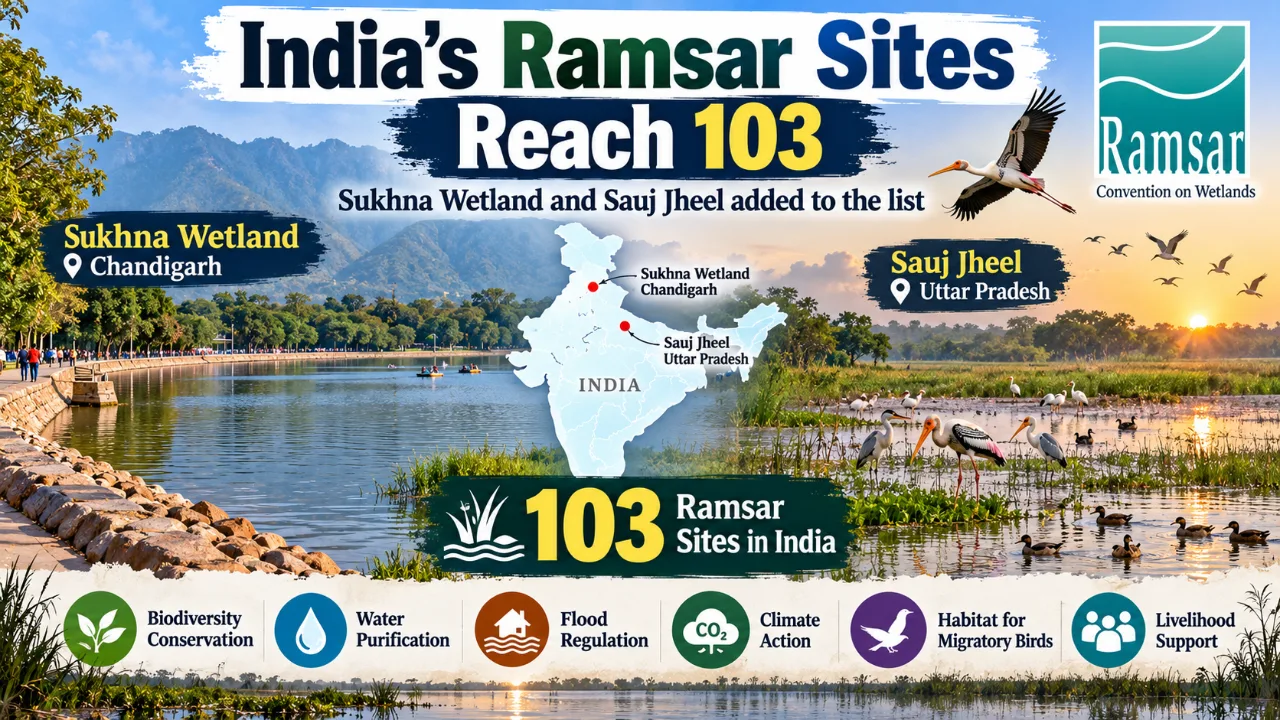
NEW DELHI, October 17, 2026: India has strengthened its international wetland conservation profile with the addition of two new sites to the Ramsar List. On October 15, 2026, the Ministry of Environment, Forest and Climate Change announced that Sukhna Wetland in Chandigarh and Sauj Jheel in Uttar Pradesh had been designated as Wetlands of International Importance, taking India's reported total to 103 sites.
The announcement brings renewed attention to wetlands, which support biodiversity, regulate water flows, store carbon in certain ecosystems, reduce flood risks and sustain local livelihoods. However, international recognition alone does not guarantee ecological recovery. Long-term conservation depends on catchment management, pollution control, sustainable land use and effective implementation of environmental regulations.
For India, wetland protection is closely connected to water security, urban planning, climate resilience, biodiversity conservation and sustainable development.
1. Why Is This in the News?
On October 15, 2026, the Union Ministry of Environment, Forest and Climate Change announced the addition of Sukhna Wetland and Sauj Jheel to the Ramsar List.
According to the ministry's announcement, India's Ramsar site count has reached 103.
The development is relevant because both sites illustrate the ecological importance of wetlands in different landscapes. Sukhna is associated with an urban reservoir and its surrounding catchment, while Sauj Jheel is an important wetland landscape in Uttar Pradesh.
The new designations also provide an opportunity to examine the international framework for wetland conservation and the domestic legal mechanisms that govern wetland protection in India.
Current-affairs takeaway: A Ramsar designation recognises a wetland's international importance, but maintaining its ecological character requires continuous management and monitoring.
2. What Is a Wetland?
Wetlands are ecosystems in which water plays a central role in determining the environment and the associated plant and animal communities.
They may be permanently or seasonally inundated, and they can contain freshwater, brackish water or saline water.
Common examples include:
Lakes and ponds
Marshes and swamps
Floodplains and riverine wetlands
Mangroves and tidal wetlands
Peatlands
Certain shallow coastal and marine areas
Wetlands form a transition between terrestrial and aquatic ecosystems. Their ecological characteristics depend on water depth, duration of inundation, soil conditions, vegetation, nutrient availability and connections with surrounding rivers or groundwater.
Not every wetland looks like a permanent lake. Seasonal wetlands can remain dry for part of the year while continuing to perform important ecological functions.
Major Types of Wetlands
Inland wetlands: Lakes, marshes, floodplains and freshwater swamps.
Coastal wetlands: Mangroves, tidal marshes, lagoons and some estuarine habitats.
Human-made wetlands: Certain reservoirs, aquaculture ponds, salt pans and wastewater treatment wetlands can support wetland functions, although their ecological value varies according to their condition and management.
3. Why Are Wetlands Ecologically Important?
Wetlands are often described as ecological infrastructure because they provide several services that would otherwise require expensive engineered systems or be difficult to replace.
A. Biodiversity Conservation
Wetlands provide feeding, breeding, nesting and resting habitats for fish, amphibians, reptiles, insects and birds.
They are particularly important for migratory waterbirds, many of which depend on a chain of suitable wetlands along their migration routes.
The loss of one important site can reduce the availability of food and resting habitat across a much larger geographical area.
B. Flood Regulation
Wetlands can temporarily store excess water and slow its movement through the landscape. Floodplains and suitable wetland systems may reduce peak flood levels by providing space for water to spread.
However, the degree of protection depends on the wetland's size, location, soil, vegetation, water levels and connection to the wider river basin. Wetlands cannot eliminate every flood risk, particularly during extreme rainfall events.
C. Water Purification
Wetland vegetation, soils and microorganisms can retain sediments and transform or remove certain pollutants and nutrients.
These processes may improve water quality, but their capacity is limited. Excessive sewage, industrial effluents or other contaminants can overwhelm a wetland and damage its ecosystem.
Wetlands should therefore complement, not replace, effective sewage treatment and pollution prevention.
D. Climate Regulation
Some wetlands, particularly peatlands and certain coastal ecosystems, store substantial quantities of carbon in vegetation and waterlogged soils.
When these ecosystems are drained or degraded, stored carbon may be released into the atmosphere. Healthy wetlands can therefore contribute to climate mitigation and adaptation.
Not all wetlands store carbon at the same rate, and some can emit methane. Their climate effects depend on ecosystem type, hydrology and management.
E. Livelihoods and Local Economies
Wetlands support fishing, agriculture in surrounding landscapes, tourism and other livelihood activities.
Their ecological degradation can affect food security, water availability, local employment and cultural practices.
Conservation strategies are more likely to succeed when local communities participate in planning and when legitimate livelihood needs are considered.
4. Sukhna Wetland, Chandigarh: An Urban Wetland Under Ecological Pressure
Sukhna Wetland lies at the edge of Chandigarh, near the foothills of the Outer Himalayas. It is associated with Sukhna Lake, a reservoir created as part of the city's planned landscape.
The wetland and its catchment influence local water and sediment flows. Its habitats support resident waterbirds and migratory species travelling along the Central Asian Flyway.
The site illustrates the importance of urban and peri-urban wetlands. Even when surrounded by developed areas, such ecosystems can provide habitat, moderate local hydrological processes and offer recreational and educational benefits.
Key Conservation Challenges
Catchment degradation: Changes in land use and vegetation can increase sediment runoff into the reservoir.
Urban pressures: Construction, tourism and recreational activities can place pressure on habitats and water quality.
Pollution: Wastewater, litter and nutrient inputs can affect ecological conditions.
Invasive species and habitat changes: Alterations in vegetation and aquatic communities may change the availability of food and shelter for native wildlife.
What Is the Way Forward?
Sukhna's long-term management requires attention to the entire catchment, not just the visible lake.
Priorities include controlling soil erosion, managing stormwater, preventing untreated wastewater discharge, monitoring biodiversity and ensuring that recreation does not compromise ecological functions.
The case demonstrates why urban planning and environmental conservation must operate together.
5. Sauj Jheel, Uttar Pradesh: Why Local Wetlands Matter
Sauj Jheel in Uttar Pradesh is the second wetland included in the October 2026 announcement.
The designation draws attention to the role of inland wetlands in supporting biodiversity and maintaining the ecological functions of the surrounding landscape.
Wetlands in agricultural regions can provide habitat for waterbirds and other wildlife, support local water regimes and contribute to the ecological health of nearby land and water systems.
Key Issues for Conservation
Wetlands in densely used agricultural landscapes may face several pressures:
Drainage and land conversion
Encroachment and changes in land ownership or land use
Agricultural runoff containing fertilisers and pesticides
Disposal of domestic waste and untreated wastewater
Changes in water inflows and seasonal hydrology
Disturbance of bird habitats and unsustainable resource extraction
These are general threats faced by many inland wetlands; the presence and severity of each pressure at Sauj Jheel must be established through site-specific monitoring.
Conservation Priorities
An effective management approach should map the wetland and its zone of influence, assess seasonal water levels, monitor water quality, protect feeding and breeding habitats and involve local communities.
A site-specific management plan is essential because conservation measures suitable for an urban reservoir may not be appropriate for a seasonal agricultural wetland.
6. What Is the Ramsar Convention?
The Convention on Wetlands, commonly known as the Ramsar Convention, is an international treaty adopted in Ramsar, Iran, on February 2, 1971.
It entered into force in 1975 and provides a framework for the conservation and wise use of wetlands.
India became a Contracting Party on February 1, 1982.
The convention is named after the Iranian city where it was adopted. World Wetlands Day is observed every year on February 2 to mark its adoption.
Three Core Pillars of the Convention
1. Wise use of all wetlands: Parties are expected to promote the conservation and sustainable use of wetlands within their territories.
2. Designation and management of Ramsar Sites: Countries identify suitable wetlands for inclusion in the List of Wetlands of International Importance and work towards maintaining their ecological character.
3. International cooperation: Parties cooperate on shared wetlands, transboundary water systems, migratory species and other matters of common interest.
What Does Ramsar Designation Mean?
Ramsar designation recognises a wetland's international importance based on criteria related to ecological character, biodiversity and other values.
It places emphasis on maintaining the site's ecological character and encourages appropriate management, monitoring and cooperation.
However, Ramsar designation does not automatically prohibit every human activity at a site. The specific legal restrictions and permitted uses depend on applicable national and local laws, site conditions and management arrangements.
UPSC fact: The Ramsar Convention is an intergovernmental treaty. The Ramsar List is the list of wetlands designated by Contracting Parties as internationally important.
7. Ramsar Criteria: How Is a Wetland Selected?
The Ramsar Convention provides nine criteria for identifying Wetlands of International Importance.
A wetland may qualify because it:
Represents a rare or unique wetland type within a relevant biogeographical region.
Supports vulnerable, endangered or critically endangered species or threatened ecological communities.
Supports important biological diversity.
Provides habitat for species at critical stages of their life cycles or during adverse conditions.
Regularly supports 20,000 or more waterbirds.
Regularly supports a significant proportion of a waterbird population or relevant waterbird species.
Supports important native fish diversity, life-history stages or ecological interactions.
Provides an important source of food, spawning ground, nursery or migration route for fish populations.
Regularly supports one per cent of the individuals in a population of a wetland-dependent non-avian animal species.
These criteria allow different types of wetlands to qualify for different ecological reasons. A wetland does not have to meet all nine criteria to be designated.
8. India's Legal Framework for Wetland Conservation
International recognition must be supported by domestic conservation and management measures.
A. Environment (Protection) Act, 1986
The Environment (Protection) Act, 1986 provides a broad statutory framework for environmental protection and is the parent legislation under which the Wetlands (Conservation and Management) Rules, 2017 were notified.
The Act enables the Central Government to take measures for protecting and improving environmental quality and regulating activities that may harm the environment.
B. Wetlands (Conservation and Management) Rules, 2017
The Wetlands Rules, 2017 establish a regulatory framework for conserving and managing specified wetlands in India.
They provide for the identification and notification of wetlands, institutional arrangements involving State and Union Territory wetland authorities, and the regulation of specified activities.
Activities restricted under the framework include, subject to the applicable provisions, conversion for non-wetland uses, certain industrial or permanent construction activities, solid-waste dumping and discharge of untreated wastes or effluents.
The precise application of each restriction depends on the legal provisions and relevant site circumstances.
C. State and Union Territory Wetland Authorities
State and Union Territory wetland authorities play an important role in identifying wetlands, preparing management approaches, coordinating departments and implementing conservation measures.
Wetland governance requires cooperation among environmental authorities, urban and rural local bodies, water-resource agencies, pollution-control boards and local communities.
D. Constitutional Provisions
Article 48A of the Constitution directs the State to endeavour to protect and improve the environment and safeguard forests and wildlife.
Article 51A(g) establishes the fundamental duty of citizens to protect and improve the natural environment, including forests, lakes, rivers and wildlife, and to have compassion for living creatures.
These provisions are important constitutional foundations for environmental governance.
9. International Environmental Agreements Linked to Wetlands
A. Convention on Biological Diversity (CBD), 1992
The CBD aims to conserve biological diversity, promote its sustainable use and ensure the fair and equitable sharing of benefits arising from genetic resources.
Wetlands are important habitats for numerous species and can contribute to national biodiversity targets and ecosystem restoration.
The Kunming–Montreal Global Biodiversity Framework, adopted under the CBD in 2022, includes the global goal of conserving and effectively managing at least 30 per cent of terrestrial, inland water, coastal and marine areas by 2030.
This target is commonly referred to as the 30-by-30 target. It is a global framework objective, not a requirement that every individual country must independently designate exactly 30 per cent of its territory as protected areas.
B. UN Framework Convention on Climate Change (UNFCCC), 1992
Wetlands can contribute to climate mitigation and adaptation through carbon storage, water regulation and the reduction of certain climate-related risks.
The UNFCCC and the Paris Agreement provide the broader international framework for climate action. Wetland conservation can support climate objectives, although wetland protection is not itself a separate treaty obligation under the Paris Agreement.
C. Convention on Migratory Species (CMS), 1979
The Convention on the Conservation of Migratory Species of Wild Animals promotes international cooperation for migratory species.
Wetlands are essential stopover, breeding and wintering habitats for many migratory birds. Protecting a single wetland may therefore contribute to conservation efforts extending across several countries.
D. Sustainable Development Goals (SDGs)
Wetland conservation is closely connected to several United Nations Sustainable Development Goals:
SDG 6: Clean Water and Sanitation, including the protection and restoration of water-related ecosystems under Target 6.6.
SDG 13: Climate Action.
SDG 14: Life Below Water, particularly for relevant coastal and marine ecosystems.
SDG 15: Life on Land, including the protection and restoration of terrestrial and inland freshwater ecosystems.
These connections demonstrate that wetland conservation is not an isolated environmental issue; it is linked to water security, climate resilience, biodiversity and sustainable livelihoods.
10. What Is the Montreux Record?
The Montreux Record is a register of Ramsar Sites where changes in ecological character have occurred, are occurring or are likely to occur because of technological developments, pollution or other human interference.
It helps draw attention to sites requiring special conservation attention.
Inclusion in the Montreux Record is not the same as Ramsar designation. A wetland can be a Ramsar Site without being listed in the Montreux Record.
The record is therefore an important concept for understanding how international recognition can be connected to monitoring and corrective action when a wetland faces serious ecological pressures.
11. Why Does India Need Stronger Wetland Management?
Increasing the number of Ramsar Sites is an important conservation milestone, but the number of designations alone does not establish whether wetland ecosystems are improving.
Effective management requires attention to ecological outcomes.
Catchment-Based Planning
Wetlands are connected to rivers, groundwater, surrounding vegetation and land-use patterns. Their management should therefore extend beyond the wetland boundary where necessary to protect the hydrological system.
Pollution Prevention
Sewage treatment, industrial-effluent control, solid-waste management and the reduction of agricultural runoff can prevent ecological damage before restoration becomes necessary.
Scientific Monitoring
Regular assessment of water quality, water levels, habitat conditions, invasive species and biodiversity can identify ecological changes early.
Community Participation
Local residents often depend on wetlands for livelihoods, recreation and cultural practices. Participatory management can improve compliance and help reconcile conservation with legitimate local needs.
Better Urban Planning
Cities need to account for natural drainage, floodplains and wetlands while planning roads, housing and commercial development.
Restoring lost hydrological connections and protecting wetland buffers can improve resilience to extreme rainfall and other environmental stresses.
12. Challenges and the Way Forward
India's wetland conservation framework faces several practical challenges.
Fragmented governance: Wetlands may be affected by decisions made by several departments with different mandates.
Encroachment and land-use change: Development pressure can reduce wetland area or disrupt hydrological connections.
Weak implementation: Formal rules do not guarantee compliance unless authorities have sufficient capacity for monitoring and enforcement.
Pollution: Untreated sewage, industrial discharge and agricultural runoff can degrade water quality.
Climate change: Changes in rainfall, drought frequency, temperature and sea levels can alter wetland hydrology and species composition.
Insufficient public awareness: Wetlands are sometimes regarded as wastelands rather than valuable ecological systems.
A stronger approach would combine updated wetland inventories, catchment-level planning, site-specific management plans, scientific monitoring, effective pollution control and meaningful community participation.
Conservation success should be assessed through ecological indicators such as water quality, habitat condition, native biodiversity and the maintenance of natural hydrological functions—not merely through the number of sites listed internationally.
Conclusion
The addition of Sukhna Wetland and Sauj Jheel to the Ramsar List marks an important development in India's wetland conservation efforts. It also highlights a broader lesson: wetlands are essential components of ecological infrastructure, supporting biodiversity, water security, climate resilience and human livelihoods.
The Ramsar Convention provides an international framework, while India's Environment (Protection) Act, 1986 and Wetlands (Conservation and Management) Rules, 2017 provide important domestic legal mechanisms.
For India to secure lasting conservation outcomes, international recognition must be matched by effective local management, pollution prevention, scientific monitoring and community participation.
The ultimate objective is not simply to increase the number of Ramsar Sites, but to maintain healthy wetlands that continue to support nature and society.
Official Editorial PDF Edition
Verified PublicationDownload a clean, high-resolution printable copy complete with tables, formulas, and high-res photography. Free for registered readers.
Community Feedback & Editorial Ratings
All Reader Reviews (0)
No reader reviews yet for this story.
Be the first to share your rating and perspective!