










India's Conservation Framework: National Parks, Wildlife Sanctuaries, and Biosphere Reserves Decoded
A complete operational breakdown of India's protected areas, statutory provisions under the Wildlife Act, UNESCO MAB designations, and IUCN threat categories.
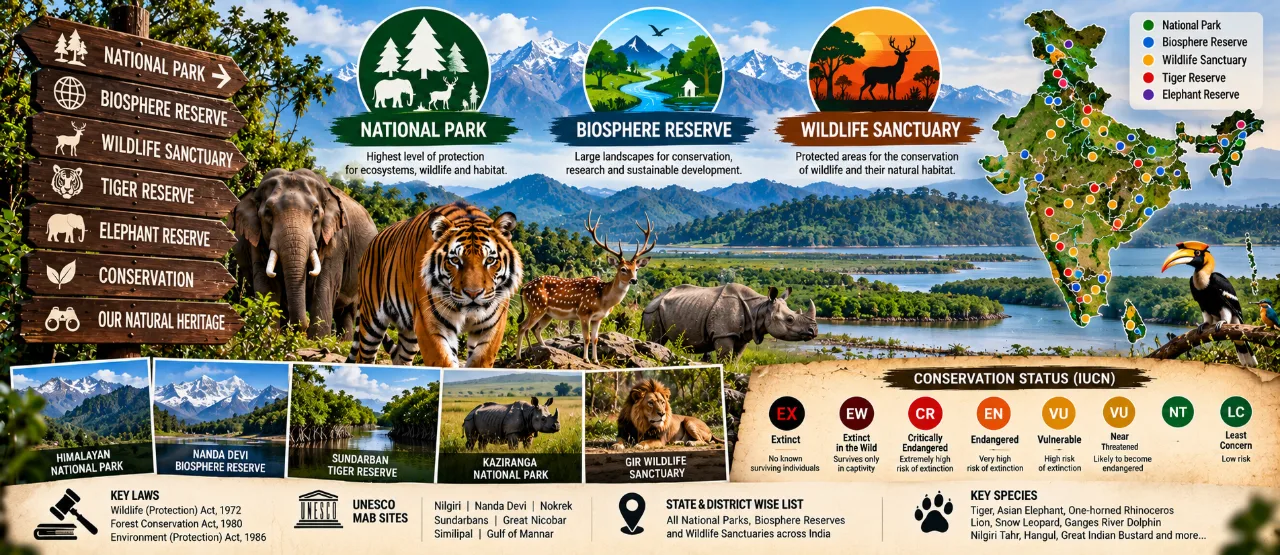
Preserving India’s Ecological Wealth: An In-Depth Look at Protected Areas
India represents one of the world's 17 megadiverse nations, encompassing nearly 8 percent of globally recorded biodiversity within merely 2.4 percent of Earth's total land area. To safeguard this fragile heritage, the country has built a robust protected area network structured across three central conservation classifications: National Parks, Wildlife Sanctuaries, and Biosphere Reserves.
While these terms are frequently conflated in everyday discourse, they embody distinct administrative mandates, legal constraints, ecological objectives, and international recognitions. From legislative backing under the Wildlife (Protection) Act of 1972 to global designations under UNESCO's Man and the Biosphere (MAB) program, each framework addresses biodiversity conservation through specialized mechanisms.
The Core Differences: National Parks vs. Wildlife Sanctuaries vs. Biosphere Reserves
Understanding the statutory boundaries and functional variations between these designations is fundamental to comprehending Indian ecological governance.
1. National Parks
Total Count in India: 106 official National Parks.
Governing Authority: Established primarily under Section 35 of the Wildlife (Protection) Act, 1972.
Degree of Protection: Highest level of statutory security. Private rights, land ownership, human habitation, and cattle grazing are strictly prohibited.
Focus: Habitat-level preservation aimed at protecting complete ecosystems, including floral, faunal, and geomorphological features.
Boundary Alterations: Boundaries cannot be shifted or revised without formal recommendation from the National Board for Wildlife (NBWL).
2. Wildlife Sanctuaries
Total Count in India: 573 established Wildlife Sanctuaries (covering roughly 3.73 percent of India's geographic area).
Governing Authority: Designated under Section 18 of the Wildlife (Protection) Act, 1972.
Degree of Protection: Moderate level of restriction. Certain regulated human activities, such as timber harvesting, minor forest product collection, and controlled livestock grazing, may be permitted by the Chief Wildlife Warden, provided they do not disrupt wildlife welfare.
Focus: Often species-oriented, tailored to secure viable populations of particular flora or fauna.
Upgradation: A Wildlife Sanctuary can be upgraded into a National Park, but a National Park cannot be demoted to a sanctuary.
3. Biosphere Reserves
Total Count in India: 18 notified Biosphere Reserves.
Governing Concept: Modeled after UNESCO's Man and the Biosphere (MAB) Program initiated in 1971, though designated nationally by the Ministry of Environment, Forest and Climate Change (MoEFCC).
Zonation: Divided into three interconnected zones:
Core Area: Strictly legally protected pristine zone with zero human intervention, usually comprising an existing National Park or Wildlife Sanctuary.
Buffer Zone: Surrounds the core; open to controlled research, education, and eco-friendly tourism.
Transition Zone (Zone of Cooperation): Outermost area where local communities engage in sustainable economic, agricultural, and settlement practices.
Focus: Integrates biological conservation with sustainable socio-economic development and traditional ecological stewardship.
"The critical distinction lies in human integration: National Parks isolate ecosystems from anthropogenic pressure, Sanctuaries manage species-specific habitats, and Biosphere Reserves harmonize human existence with biodiversity conservation."
Statutory Acts and Regulations Governing Conservation
India’s wildlife protection apparatus relies on a series of specialized legislative enactments:
The Wildlife (Protection) Act, 1972 (amended in 2022): Provides the statutory charter for establishing National Parks, Sanctuaries, Conservation Reserves, and Community Reserves. The 2022 amendment restructured protected species schedules and implemented the provisions of CITES (Convention on International Trade in Endangered Species of Wild Fauna and Flora).
The Forest (Conservation) Act, 1980: Strictly restricts the diversion of designated forest lands for non-forest purposes without prior Central Government authorization.
The Environment (Protection) Act, 1986: Serves as umbrella legislation enabling the notification of Eco-Sensitive Zones (ESZs) surrounding National Parks and Sanctuaries to mitigate peripheral industrial contamination.
The Biological Diversity Act, 2002: Formulated to meet obligations under the United Nations Convention on Biological Diversity (CBD), decentralizing biodiversity conservation via local Biodiversity Management Committees (BMCs).
India's 18 Biosphere Reserves and the 12 UNESCO MAB Sites
India has demarcated 18 Biosphere Reserves across key biogeographic zones. Of these, 12 have received international endorsement under the UNESCO World Network of Biosphere Reserves (WNBR).
The 12 Globally Recognized UNESCO MAB Sites:
Nilgiri Biosphere Reserve (Notified 1986, MAB 2000): Tamil Nadu, Kerala, and Karnataka (Wayanad, Nagarhole, Bandipur, Mudumalai, Silent Valley). Flagship: Lion-tailed Macaque, Nilgiri Tahr.
Gulf of Mannar (Notified 1989, MAB 2001): Tamil Nadu (Ramanathapuram and Thoothukudi coasts). Flagship: Dugong (Sea Cow).
Sundarbans (Notified 1989, MAB 2001): West Bengal (North and South 24 Parganas). Flagship: Royal Bengal Tiger, Estuarine Crocodile.
Nanda Devi (Notified 1988, MAB 2004): Uttarakhand (Chamoli, Pithoragarh, Bageshwar). Flagship: Snow Leopard, Himalayan Musk Deer.
Nokrek (Notified 1988, MAB 2009): Meghalaya (East, West, and South Garo Hills). Flagship: Red Panda, Asian Elephant.
Pachmarhi (Notified 1999, MAB 2009): Madhya Pradesh (Hoshangabad, Betul, Chhindwara). Flagship: Indian Giant Squirrel, Flying Squirrel.
Similipal (Notified 1994, MAB 2009): Odisha (Mayurbhanj). Flagship: Royal Bengal Tiger, Wild Asian Elephant, Chausingha.
Achanakmar-Amarkantak (Notified 2005, MAB 2012): Madhya Pradesh and Chhattisgarh (Anuppur, Dindori, Bilaspur). Flagship: Swamp Deer (Barasingha), Leopard.
Great Nicobar (Notified 1989, MAB 2013): Andaman and Nicobar Islands. Flagship: Saltwater Crocodile, Nicobar Megapode.
Agasthyamala (Notified 2001, MAB 2016): Kerala and Tamil Nadu (Thiruvananthapuram, Kollam, Tirunelveli, Kanyakumari). Flagship: Nilgiri Tahr, Asian Elephant.
Khangchendzonga (Notified 2000, MAB 2018): Sikkim (North and West Sikkim). Flagship: Snow Leopard, Musk Deer.
Panna (Notified 2011, MAB 2020): Madhya Pradesh (Panna and Chhatarpur). Flagship: Bengal Tiger, Sloth Bear, Chinkara.
Remaining 6 Nationally Designated Biosphere Reserves:
Cold Desert: Himachal Pradesh (Pin Valley, Kibber, Chandratal).
Dehang-Debang: Arunachal Pradesh (Upper Siang, Dibang Valley).
Dibru-Saikhowa: Assam (Dibrugarh, Tinsukia).
Manas: Assam (Baksa, Chirang).
Kachchh: Gujarat (Kachchh, Rajkot, Surendranagar, Patan).
Seshachalam Hills: Andhra Pradesh (Chittoor, Kadapa).
Key National Parks, Host Districts, and Flagship Conserved Species
India’s flagship species receive targeted conservation interventions in globally celebrated parks:
Kaziranga National Park (Golaghat and Nagaon, Assam): Global stronghold of the Great Indian One-horned Rhinoceros (Rhinoceros unicornis), alongside Wild Water Buffalo and Eastern Swamp Deer.
Gir National Park and Sanctuary (Junagadh and Gir Somnath, Gujarat): The last remaining natural refuge on Earth for the Asiatic Lion (Panthera leo leo).
Jim Corbett National Park (Nainital and Pauri Garhwal, Uttarakhand): India's inaugural National Park (founded in 1936 as Hailey National Park), premier territory for Project Tiger.
Ranthambore National Park (Sawai Madhopur, Rajasthan): Renowned deciduous habitat safeguarding the Royal Bengal Tiger, Caracal, and Marsh Crocodile.
Hemis National Park (Leh, Ladakh): India’s largest National Park by area, dedicated to the Snow Leopard and Bharal (Blue Sheep).
Keibul Lamjao National Park (Bishnupur, Manipur): The world’s only floating national park on Loktak Lake, preserving the Sangai (Eld's Deer, or dancing deer).
IUCN Red List Categories: Global Definitions and Key Indian Species
The International Union for Conservation of Nature (IUCN) assesses species vulnerability across standardized extinction-risk categories. Understanding these designations clarifies conservation priorities across India's wilderness areas:
1. Extinct (EX)
A taxon is Extinct when there is no reasonable doubt that the last individual has died after thorough surveys throughout its historic range.
Indian Context: Asiatic Cheetah (Acinonyx jubatus venaticus) was officially declared locally extinct in India in 1952 (reintroduced via African subspecies in 2022); Pink-headed Duck (last confirmed sighting in 1935).
2. Extinct in the Wild (EW)
Species known only to survive in cultivation, captivity, or as naturalized populations well outside their historic range.
Indian Context: Certain regional endemic freshwater fish and plant taxa maintained solely in botanical ex-situ collections.
3. Critically Endangered (CR)
Faces an extremely elevated risk of extinction in the wild, defined by severe population reduction (greater than 80-90 percent over three generations) or restricted adult populations (under 250 individuals).
Indian Species: Great Indian Bustard (Ardeotis nigriceps), Gharial (Gavialis gangeticus), Bengal Florican, White-rumped Vulture, Indian Vulture, Pygmy Hog, and Namdapha Flying Squirrel.
4. Endangered (EN)
Faces a very high risk of extinction in the wild, driven by population declines surpassing 50-70 percent or adult numbers under 2,500.
Indian Species: Royal Bengal Tiger (Panthera tigris), Asian Elephant (Elephas maximus), Asiatic Lion, Ganges River Dolphin, Nilgiri Tahr, Lion-tailed Macaque, and Red Panda.
5. Vulnerable (VU)
Taxa experiencing high risk of wild endangerment due to population contraction (over 30-50 percent) or small geographical occupancy.
Indian Species: Greater One-horned Rhinoceros, Snow Leopard (Panthera uncia), Clouded Leopard, Sloth Bear, Dugong, Olive Ridley Sea Turtle, and Gaur (Indian Bison).
6. Near Threatened (NT)
Taxa that do not currently qualify for Critically Endangered, Endangered, or Vulnerable, but are close to qualifying or likely to qualify in the near future.
Indian Species: Blackbuck, Striped Hyena, Himalayan Griffon Vulture.
7. Least Concern (LC)
Taxa that have been comprehensively evaluated and determined to be widespread and abundant.
Indian Species: Rhesus Macaque, Common Myna, Indian Peafowl.
List of Important National Parks, Sanctuaries and Wildlife Landscapes by State
The following list provides high-value examples for examination preparation. It is illustrative rather than a complete inventory of every protected area in India.
Northern India
Uttarakhand
Jim Corbett National Park — Nainital and Pauri Garhwal region; Bengal tiger.
Rajaji National Park — Dehradun, Haridwar and adjoining areas; Asian elephant.
Nanda Devi National Park — Chamoli district; Himalayan biodiversity.
Valley of Flowers National Park — Chamoli district; alpine flora and high-altitude ecosystems.
Himachal Pradesh
Great Himalayan National Park — Kullu district; Himalayan biodiversity and western tragopan habitat.
Pin Valley National Park — Lahaul and Spiti district; snow leopard and cold-desert wildlife.
Cold Desert Biosphere Reserve — high-altitude ecosystems in Himachal Pradesh.
Ladakh
Hemis National Park — mainly the Indus and Markha valley landscape; snow leopard.
Changthang Wildlife Sanctuary — high-altitude plateau; kiang, black-necked crane and other cold-desert species.
Jammu and Kashmir
Dachigam National Park — Srinagar region; Hangul or Kashmir stag.
Kishtwar National Park — Kishtwar district; Himalayan mountain wildlife.
Western India
Gujarat
Gir National Park and Wildlife Sanctuary — Saurashtra; Asiatic lion.
Marine National Park, Gulf of Kutch — Jamnagar region; coral reefs and marine biodiversity.
Indian Wild Ass Sanctuary — Little Rann of Kutch; Indian wild ass.
Velavadar Blackbuck National Park — Bhavnagar district; blackbuck and grassland birds.
Rajasthan
Ranthambore National Park — Sawai Madhopur district; Bengal tiger.
Sariska Tiger Reserve — Alwar district; tiger and dry-deciduous forest species.
Keoladeo National Park — Bharatpur district; wetland birds.
Desert National Park — Jaisalmer and Barmer region; great Indian bustard habitat.
Maharashtra
Tadoba National Park and Tiger Reserve — Chandrapur district; Bengal tiger.
Sanjay Gandhi National Park — Mumbai and adjoining Thane region; urban forest biodiversity.
Navegaon National Park — Gondia district; forest and wetland biodiversity.
Goa
Mollem National Park — Western Ghats landscape; evergreen forests and endemic wildlife.
Bhagwan Mahavir Wildlife Sanctuary — Western Ghats; mammals, birds and forest biodiversity.
Central India
Madhya Pradesh
Kanha National Park — Mandla and Balaghat districts; tiger and hard-ground barasingha.
Bandhavgarh National Park — Umaria district; Bengal tiger.
Pench National Park — Madhya Pradesh–Maharashtra landscape; tiger and central Indian forest fauna.
Kuno National Park — Sheopur district; reintroduced African cheetahs and native wildlife.
Panna National Park — Panna and adjoining districts; tiger and riverine habitats.
Pachmarhi Biosphere Reserve — Satpura region; forest ecosystems and biodiversity.
Chhattisgarh
Indravati National Park — Bijapur district; central Indian forest fauna, including wild buffalo conservation concerns.
Kanger Valley National Park — Bastar district; caves, forests and endemic biodiversity.
Achanakmar Wildlife Sanctuary — forest landscape in the Bilaspur region; part of the broader Achanakmar-Amarkantak biosphere-reserve landscape.
Eastern India
West Bengal
Sundarbans National Park — South 24 Parganas; Bengal tiger, estuarine crocodile and mangrove biodiversity.
Buxa National Park and Tiger Reserve — Alipurduar district; elephants, tigers and Himalayan foothill forests.
Jaldapara National Park — Alipurduar district; greater one-horned rhinoceros.
Gorumara National Park — Jalpaiguri district; rhinoceros, elephants and grassland wildlife.
Neora Valley National Park — Kalimpong district; red panda habitat and Eastern Himalayan forests.
Singalila National Park — Darjeeling district; red panda and high-altitude Himalayan species.
Sundarban Biosphere Reserve — the wider mangrove landscape in southern West Bengal.
Odisha
Similipal National Park and Tiger Reserve — Mayurbhanj district; tiger, elephant and forest biodiversity.
Bhitarkanika National Park — Kendrapara district; saltwater crocodiles and mangroves.
Gahirmatha Marine Wildlife Sanctuary — coastal Odisha; Olive Ridley sea turtles.
Satkosia Tiger Reserve — Angul and adjoining districts; river gorge and forest ecosystems.
Jharkhand
Betla National Park — Latehar district; elephants, deer and other forest species.
Dalma Wildlife Sanctuary — East Singhbhum region; Asian elephant.
Bihar
Valmiki National Park and Tiger Reserve — West Champaran district; Bengal tiger.
Vikramshila Gangetic Dolphin Sanctuary — Bhagalpur district; Ganges river dolphin.
Northeastern India
Assam
Kaziranga National Park — central Assam; greater one-horned rhinoceros.
Manas National Park — Assam–Bhutan foothills; tiger, elephant and rare grassland species.
Orang National Park — Darrang and Sonitpur region; rhinoceros and floodplain wildlife.
Nameri National Park — Sonitpur district; forest biodiversity and riverine habitats.
Dibru-Saikhowa National Park — Dibrugarh and Tinsukia region; wetlands, grasslands and feral horses.
Pobitora Wildlife Sanctuary — Morigaon district; one-horned rhinoceros.
Arunachal Pradesh
Namdapha National Park — Changlang district; tropical and subtropical forest wildlife.
Pakke Tiger Reserve — Pakke Kessang region; hornbills, tigers and elephants.
Eaglenest Wildlife Sanctuary — West Kameng district; exceptional bird diversity.
Meghalaya
Nokrek National Park — Garo Hills; forest biodiversity.
Balpakram National Park — South Garo Hills; elephants and rich forest fauna.
Sikkim
Khangchendzonga National Park — high-altitude Sikkim; snow leopard, red panda and Himalayan biodiversity.
Tripura
Clouded Leopard National Park — Sepahijala Wildlife Sanctuary complex; clouded leopard and forest fauna.
Rajbari National Park, also known as Bison National Park — Trishna Wildlife Sanctuary landscape in South Tripura; gaur and other wildlife.
Manipur
Keibul Lamjao National Park — Bishnupur district; the endangered Sangai deer and floating phumdi ecosystem.
Mizoram
Murlen National Park — Champhai district; forest biodiversity.
Phawngpui National Park — Lawngtlai district; montane forests and rare birds.
Nagaland
Ntangki (Intanki) National Park — Peren district; forest biodiversity and mammals.
Southern India
Karnataka
Bandipur National Park — Mysuru and Chamarajanagar region; tiger and elephant.
Nagarahole National Park — Kodagu and Mysuru region; tiger and elephant.
Bannerghatta National Park — Bengaluru region; forest wildlife and conservation education.
Kudremukh National Park — Chikkamagaluru and adjoining Western Ghats landscape; endemic biodiversity.
Kerala
Periyar National Park and Tiger Reserve — Idukki region; elephants, tigers and lake–forest ecosystems.
Eravikulam National Park — Idukki district; Nilgiri tahr.
Silent Valley National Park — Palakkad district; tropical evergreen forests and endemic species.
Wayanad Wildlife Sanctuary — Wayanad district; elephants, tigers and Western Ghats biodiversity.
Tamil Nadu
Mudumalai National Park and Tiger Reserve — Nilgiris district; tiger and elephant.
Mukurthi National Park — Nilgiris district; Nilgiri tahr and montane grasslands.
Gulf of Mannar Marine National Park — Ramanathapuram and Thoothukudi coastal region; coral reefs, seagrass and marine species.
Guindy National Park — Chennai; urban biodiversity.
Andhra Pradesh
Sri Venkateswara National Park — Tirupati region; Eastern Ghats biodiversity.
Papikonda National Park — Godavari river landscape; forest and riverine ecosystems.
Coringa Wildlife Sanctuary — Kakinada region; mangroves and coastal biodiversity.
Telangana
Kasu Brahmananda Reddy National Park — Hyderabad; urban biodiversity.
Amrabad Tiger Reserve — Nagarkurnool and adjoining forest landscapes; tiger and dry-deciduous forest species.
Kawal Tiger Reserve — northern Telangana; tiger and forest habitat conservation.
Island Territories
Andaman and Nicobar Islands
Mahatma Gandhi Marine National Park — South Andaman region; coral reefs and marine biodiversity.
Campbell Bay National Park — Great Nicobar Island; tropical rainforest and island wildlife.
Galathea National Park — Great Nicobar Island; coastal and forest ecosystems.
Great Nicobar Biosphere Reserve — Great Nicobar Island; unique island biodiversity.
This state-wise selection should be used alongside updated official notifications for questions requiring exact boundaries, district coverage or the latest legal designation.
7. Important Species Protected in India
Protected areas are established for entire ecosystems, but certain species become conservation priorities because of their ecological role, declining populations, restricted distribution or threats from habitat loss and human activity.
Bengal Tiger
The Bengal tiger is an apex predator and a flagship species for forest conservation. Tiger reserves are managed under the framework of Project Tiger and the Wildlife (Protection) Act, 1972.
Important landscapes include Corbett, Kaziranga, Sundarbans, Kanha, Bandhavgarh, Ranthambore, Bandipur and Tadoba.
IUCN status: Endangered at the species level for the tiger (Panthera tigris).
Asiatic Lion
The Asiatic lion survives naturally in the Gir landscape of Gujarat. Conservation efforts focus on habitat management, disease preparedness, prey availability and the long-term security of the population.
IUCN status: Vulnerable at the species level for the lion (Panthera leo). The status of a subspecies or geographically distinct population can differ from that of the species as a whole.
Greater One-Horned Rhinoceros
The greater one-horned rhinoceros is strongly associated with Assam’s floodplain grasslands and wetlands, particularly Kaziranga. Other important landscapes include Pobitora and Jaldapara.
IUCN status: Vulnerable.
Asian Elephant
Asian elephants require large connected habitats and migration corridors. Major conservation landscapes include the Western Ghats, northeastern India, central and eastern India, and parts of the Himalayan foothills.
Threats include habitat fragmentation, railway and road collisions, poaching and human–elephant conflict.
IUCN status: Endangered.
Snow Leopard
The snow leopard inhabits high-altitude mountain ecosystems in Ladakh, Himachal Pradesh, Uttarakhand and parts of other Himalayan states.
Hemis National Park and Pin Valley National Park are important examples of snow-leopard landscapes.
IUCN status: Vulnerable.
Red Panda
The red panda inhabits temperate Himalayan forests with suitable bamboo resources. In India, important landscapes include parts of Sikkim, Arunachal Pradesh and the Darjeeling–Kalimpong region of West Bengal.
IUCN status: Endangered.
Sangai Deer
The Sangai, or brow-antlered deer, is associated with the floating phumdi ecosystem of Loktak Lake in Manipur. Keibul Lamjao National Park is particularly important for its survival.
IUCN status: Endangered.
Great Indian Bustard
The great Indian bustard is a critically threatened grassland bird. Remaining populations face habitat loss, infrastructure-related mortality and other pressures, particularly in parts of Rajasthan and Gujarat.
IUCN status: Critically Endangered.
Ganges River Dolphin
The Ganges river dolphin inhabits river systems in northern and eastern India. River flow, water quality, fishing pressure and habitat fragmentation are important conservation concerns.
IUCN status: Endangered.
Gharial
The gharial is a specialised fish-eating crocodilian that depends on suitable river channels and sandbanks for basking and nesting. The Chambal river system is one of its major conservation landscapes.
IUCN status: Critically Endangered.
Other important species
Nilgiri tahr — Endangered: High-altitude grasslands and rocky slopes of the southern Western Ghats.
Indian vulture and white-rumped vulture — Critically Endangered: Threatened by poisoning, including exposure to certain veterinary drugs.
Olive Ridley sea turtle — Vulnerable: Major mass-nesting sites occur along the Odisha coast.
Dugong — Vulnerable: Seagrass habitats, including those in the Gulf of Mannar and Andaman and Nicobar Islands, are important.
Wild water buffalo — Endangered: Important conservation landscapes remain in parts of northeastern and central India.
Species status should always be checked against the latest IUCN assessment because reassessments can change classifications.
IUCN Red List Categories: Meaning and Examples
The International Union for Conservation of Nature (IUCN) maintains the IUCN Red List of Threatened Species, a global scientific assessment of extinction risk.
It is essential to distinguish a species’ global extinction risk from its legal protection under Indian law. The IUCN Red List is not itself a domestic wildlife-protection statute.
The IUCN recognises nine main Red List categories. Three of them—Vulnerable, Endangered and Critically Endangered—are collectively described as threatened categories. Source: IUCN Red List
Important examination point: Do not confuse the IUCN category of a species with its protection schedule under Indian law. A species’ IUCN status and its domestic legal status answer different questions.
Conservation Reserves and Community Reserves
India’s statutory protected-area framework also includes conservation reserves and community reserves.
Conservation Reserve
A conservation reserve can be declared by the State Government over certain government-owned areas, particularly land adjoining or linking protected areas or areas that contain significant ecological value, in accordance with the Wildlife (Protection) Act.
These areas can help preserve wildlife corridors and connect fragmented habitats.
Community Reserve
A community reserve can be declared over certain private or community lands where individuals or communities voluntarily participate in wildlife and habitat conservation, subject to the Act’s provisions.
Community participation is particularly important where ecological connectivity depends on lands outside conventional national parks and sanctuaries.
Strategic Outlook for Indian Ecosystems
India’s wildlife strategy is progressively shifting toward comprehensive landscape-level conservation. With corridors linking fragmented habitats and community participation embedded within fringe zones, the preservation of National Parks, Sanctuaries, and Biosphere Reserves remains central to maintaining ecological stability across South Asia.
Official Editorial PDF Edition
Verified PublicationDownload a clean, high-resolution printable copy complete with tables, formulas, and high-res photography. Free for registered readers.
Community Feedback & Editorial Ratings
All Reader Reviews (0)
No reader reviews yet for this story.
Be the first to share your rating and perspective!