










IceCube Neutrino Observatory: How Antarctic Ice Is Revealing the Universe’s Hidden Secrets
Deep beneath the South Pole, thousands of light sensors detect elusive cosmic neutrinos, helping scientists investigate black holes, distant galaxies and the universe’s most energetic phenomena.
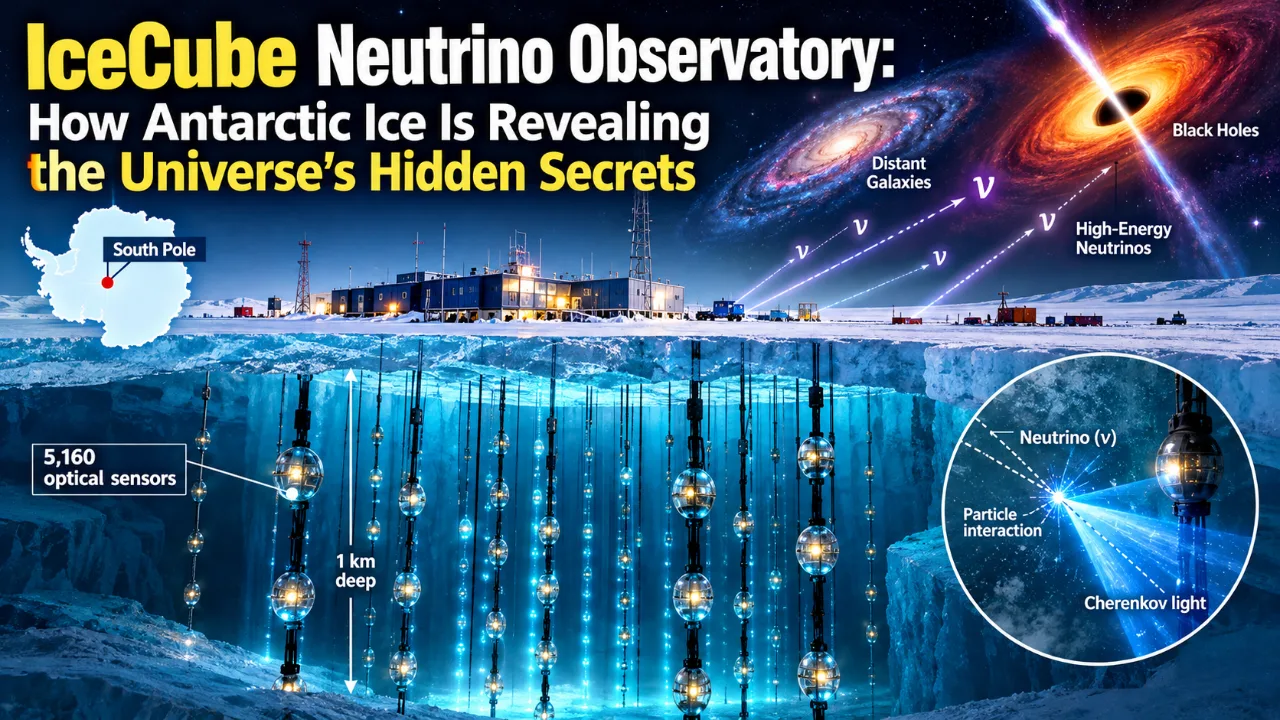
IceCube Neutrino Observatory: How Antarctic Ice Is Revealing the Universe’s Hidden Secrets
Deep beneath the frozen landscape of Antarctica, an extraordinary scientific observatory is helping humanity explore some of the universe’s most mysterious phenomena. The IceCube Neutrino Observatory uses a vast volume of natural ice to detect elusive subatomic particles known as neutrinos, which can travel across cosmic distances while interacting only rarely with matter.
Unlike conventional telescopes that observe light, IceCube detects tiny flashes produced when neutrinos interact with the ice. These observations allow scientists to investigate extreme cosmic environments, including active galaxies and other powerful astrophysical systems.
The research associated with IceCube has helped establish neutrino astronomy as a new way to study the universe. Francis Halzen, whose contributions to the observatory were recognised with the 2026 Nobel Prize in Physics, played a central role in developing this ambitious scientific project.
1. What Are Neutrinos?
Neutrinos are fundamental particles that have no electric charge and interact extremely weakly with ordinary matter. They are among the most abundant particles in the universe, yet detecting them is extraordinarily difficult.
Trillions of neutrinos pass through the human body every second, mostly without interacting with its atoms. Many originate from the Sun and Earth's atmosphere, while others are produced in distant astronomical environments.
Because neutrinos carry no electric charge, magnetic fields do not bend their paths. They can also escape from dense environments that may absorb or scatter light.
These properties make neutrinos valuable messengers. By studying their energies and arrival directions, researchers can investigate the physical processes that produce them and search for the cosmic objects responsible.
2. Why Do Scientists Study High-Energy Neutrinos?
The universe contains environments where matter and energy behave under extreme conditions. Supernova explosions, active galactic nuclei and powerful jets associated with supermassive black holes are among the phenomena scientists investigate.
High-energy neutrinos can provide evidence about processes occurring in these environments. Their detection may help researchers understand how cosmic particles are accelerated to extraordinary energies and how energetic interactions take place far beyond Earth.
However, identifying a neutrino's source is challenging. A single detection may provide only limited information, so scientists analyse many events, compare their directions and energies, and examine whether other observatories have detected related signals.
Neutrino astronomy therefore works alongside conventional astronomy, using different messengers to build a more complete picture of cosmic events.
3. What Is the IceCube Neutrino Observatory?
Located at the National Science Foundation's Amundsen–Scott South Pole Station, IceCube is a giant particle detector embedded deep within Antarctic ice.
The observatory instruments approximately one cubic kilometre of ice with thousands of optical sensors. Its main detector consists of 5,160 digital optical modules deployed along 86 strings beneath the surface.
The sensors are positioned deep enough to use the exceptionally clear ice as a detection medium. The enormous volume increases the chance of observing the rare interactions produced by high-energy neutrinos.
Construction was completed in 2010, and IceCube became a major instrument for studying high-energy particles from space.
The project is operated by an international scientific collaboration led by the University of Wisconsin–Madison, with major support from the U.S. National Science Foundation and partner institutions.
4. How Does IceCube Detect Neutrinos?
IceCube does not photograph neutrinos directly. Instead, it detects the light generated by secondary particles created when a neutrino interacts with matter.
The process involves four main stages.
Stage 1: A neutrino reaches Earth. A high-energy neutrino travels from its source through space and eventually reaches the Antarctic detector.
Stage 2: A rare interaction occurs. The neutrino occasionally interacts with an atomic nucleus in or near the instrumented ice, producing secondary charged particles.
Stage 3: Cherenkov light is produced. Some of these particles travel faster than light can travel through ice. They emit a faint blue glow known as Cherenkov radiation.
Stage 4: Sensors record the event. IceCube's optical modules measure the timing and intensity of the light. Scientists analyse these measurements to reconstruct the event and estimate the neutrino's energy and direction.
Since these interactions are extremely rare, a detector of enormous size is essential. The ice itself provides the material through which the interactions and resulting light signals can be observed.
5. Major Scientific Discoveries Made Possible by IceCube
2013: The Discovery of High-Energy Astrophysical Neutrinos
In 2013, the IceCube Collaboration reported the first strong evidence of high-energy neutrinos originating beyond the Solar System.
The researchers identified 28 very high-energy neutrino events in the data analysed for the discovery. The findings demonstrated that IceCube could detect a cosmic neutrino signal that could not be explained by known atmospheric backgrounds alone.
This achievement marked a major milestone in the development of neutrino astronomy, opening a new way to investigate distant cosmic accelerators.
2018: A Potential Source in a Distant Active Galaxy
In 2017, IceCube detected a high-energy neutrino from the direction of TXS 0506+056, a blazar that was also observed producing increased gamma-ray emission.
The observations reported in 2018 provided important evidence connecting high-energy neutrinos with an identifiable astrophysical object.
A blazar is an active galaxy powered by material surrounding a supermassive black hole, with a powerful jet directed approximately towards Earth. The result helped scientists investigate whether such systems contribute to the production of high-energy cosmic particles.
2022–2023: Neutrino Emission From the Galaxy NGC 1068
IceCube analyses identified evidence of neutrino emission associated with NGC 1068, also known as Messier 77, an active galaxy relatively close to the Milky Way on cosmic scales.
The result was an important development because it suggested that active galaxies could be studied through their neutrino emissions, providing clues about energetic processes hidden within them.
In 2023, IceCube researchers also published a neutrino-based image of the Milky Way, demonstrating how these particles can reveal information about processes occurring within our own galaxy.
Together, these discoveries show how neutrinos are becoming an increasingly important tool for studying cosmic environments.
6. What Can Neutrinos Reveal About Black Holes and Distant Galaxies?
Supermassive black holes can power active galactic nuclei, where matter surrounding the black hole releases enormous amounts of energy. Some of these systems generate powerful jets that extend far beyond their host galaxies.
Scientists are investigating whether these environments accelerate cosmic rays and produce high-energy neutrinos through interactions involving particles and radiation.
Neutrinos are particularly useful because they can escape dense regions that may prevent other signals from travelling freely. Detecting them can therefore provide clues about processes that are difficult to investigate through light alone.
However, the presence of a neutrino does not automatically establish that a particular black hole or galaxy produced it. Researchers must combine statistical analysis, directional information and observations from other instruments to build a convincing case.
7. Why Is Antarctica an Ideal Location?
The South Pole offers a unique environment for a detector of this scale.
The deep Antarctic ice is exceptionally transparent, allowing faint flashes of Cherenkov light to travel far enough for the optical sensors to record them.
The ice also provides an enormous natural detection volume without requiring scientists to construct a conventional tank containing a cubic kilometre of water.
Building the observatory was nevertheless a formidable engineering challenge. Researchers had to drill deep holes through the ice, deploy the detector strings during short Antarctic field seasons and maintain equipment in an extremely remote environment.
The completed facility demonstrates how a natural environment can become a powerful scientific instrument when combined with innovative engineering.
8. What Are the Limitations of Neutrino Astronomy?
Despite its achievements, IceCube cannot identify every cosmic neutrino source. Neutrino interactions are rare, and the resulting signals may not always point precisely towards their origins.
Scientists must also distinguish astrophysical neutrinos from particles generated when cosmic rays interact with Earth's atmosphere.
Some high-energy neutrinos have been associated with possible cosmic sources, but many detected events remain difficult to trace to a specific object.
Researchers therefore rely on larger datasets, improved detector sensitivity and coordinated observations across different types of astronomical instruments.
The next generation of neutrino observatories aims to improve the number of detectable events and sharpen scientists' ability to identify their sources.
9. The Future of Neutrino Astronomy
Future developments in neutrino detection could help scientists investigate more distant and less luminous cosmic sources.
The proposed IceCube-Gen2 expansion is designed to increase the observatory's sensitivity to high-energy astrophysical neutrinos and improve its ability to study the universe's most energetic environments.
Greater sensitivity could allow researchers to investigate additional active galaxies, improve measurements of cosmic neutrino populations and explore the mechanisms responsible for accelerating particles to extreme energies.
Neutrino observations may also become increasingly valuable when combined with gamma-ray telescopes, conventional optical observatories, gravitational-wave detectors and cosmic-ray experiments.
This multi-messenger approach allows scientists to compare different forms of evidence from the same cosmic events, potentially revealing details that no single instrument could establish independently.
10. The Nobel Recognition Behind the Research
In October 2026, Francis Halzen received the Nobel Prize in Physics for his decisive contributions to the IceCube Neutrino Observatory and the discovery of high-energy neutrinos of astrophysical origin.
His work helped transform the idea of using Antarctic ice as a neutrino detector into a functioning scientific observatory. The project also illustrates the importance of international collaboration, long-term funding and technological innovation in modern physics.
Although the Nobel Prize recognised Halzen's contributions, IceCube's achievements reflect the work of a broad international scientific collaboration involving physicists, engineers, technicians and research institutions.
Conclusion
The IceCube Neutrino Observatory has transformed Antarctic ice into a window on the high-energy universe. By detecting the rare flashes of light produced by neutrino interactions, scientists can investigate cosmic particles and explore the extreme environments in which they originate.
From the first strong evidence of high-energy astrophysical neutrinos to observations associated with active galaxies, IceCube has demonstrated that the universe can be studied through more than light alone.
Many questions remain unanswered, including the origins of numerous high-energy neutrinos and the precise mechanisms that produce them. Continued observations, improved instruments and international scientific cooperation will be essential to answering these questions.
The study of neutrinos is therefore not simply a story about an award or a detector. It is an expanding field of research that is changing how humanity explores the universe.
Sources and Further Reading
IceCube Neutrino Observatory: https://icecube.wisc.edu/about-us/overview/
U.S. National Science Foundation — First evidence of high-energy astrophysical neutrinos: https://www.nsf.gov/news/nsf-funded-icecube-neutrino-observatory-provides-first
IceCube research highlights: https://icecube.wisc.edu/science/research/
NASA Science — Neutrino observations and IceCube: https://science.nasa.gov/astrophysics/programs/physics-of-the-cosmos/community/nobel-prize-for-astrophysical-neutrino-observations-with-icecube/
Official Editorial PDF Edition
Verified PublicationDownload a clean, high-resolution printable copy complete with tables, formulas, and high-res photography. Free for registered readers.
Community Feedback & Editorial Ratings
All Reader Reviews (0)
No reader reviews yet for this story.
Be the first to share your rating and perspective!