



Hindu Nationalism vs Hindutva: Understanding the Difference in Indian History
From Savarkar and Tagore to Ambedkar and the Indian Constitution, explore Hindu identity, Hindutva, nationalism and the global debate over culture and citizenship.
Hindu Nationalism and Hindutva: What Is the Difference? India’s History and the Global Debate on Nationhood
Hindu identity is not the same as Hindutva. Understanding the difference requires looking beyond slogans to Indian history, political philosophy, constitutional democracy, and the universal question of who belongs to a nation.
Introduction: When Does Cultural Pride Become Political Nationalism?
Can someone be deeply Hindu, take pride in India's ancient civilisation, celebrate its festivals, study its philosophy, and still disagree with Hindutva? Can someone love India without believing that Indian national identity must be defined primarily through Hindu civilisation?
These questions matter because three ideas are frequently treated as if they mean the same thing: Hindu identity, Hindu nationalism, and Hindutva. They overlap, but they are not identical.
Hinduism is a vast collection of religious, philosophical, ritual and cultural traditions. Hindu nationalism is a political current that connects the identity of the nation with Hindu identity or civilisation. Hindutva, in its modern ideological formulation, offers a particular interpretation of Hindu nationhood and the relationship between religion, culture, territory and citizenship.
Confusing these ideas creates two opposite mistakes. One is to assume that every Hindu is a supporter of Hindutva. The other is to assume that criticism of Hindutva is necessarily hostility towards Hinduism.
Neither conclusion is intellectually defensible.
The more important question is this: Should a country's majority culture define the political identity of the entire nation, or should national belonging rest equally on citizenship, constitutional rights and shared political responsibility?
India's history offers no simple answer. But it offers enough complexity to challenge simplistic political narratives.
1. Hinduism: A Civilisation of Many Traditions
Hinduism is not a single, centrally organised religion with one universally accepted founder, one compulsory creed, or one institution that determines the beliefs of all its followers.
Its intellectual and spiritual traditions include the Upanishads, Vedanta, Samkhya, Yoga, Nyaya, Vaisheshika, Mimamsa, devotional movements, Shaiva and Vaishnava traditions, Shakta worship, local deities, philosophical scepticism and numerous regional practices.
The relationship between these traditions has never been entirely uniform. They have debated one another, borrowed ideas, developed different rituals and interpreted ultimate reality in different ways.
Some Hindu philosophical traditions emphasise a universal spiritual reality. Others focus on devotion to a personal deity. Some traditions place great importance on ritual; others emphasise knowledge, meditation or ethical conduct.
This diversity matters politically.
A Bengali Shakta devotee, a Tamil Shaiva, a Vaishnava bhakti poet, an Advaita philosopher and a Hindu who approaches religion primarily through family traditions may share a broad religious-cultural identity without agreeing on the nature of God, religious authority or social life.
There is therefore no single political conclusion that follows automatically from being Hindu.
A person's religious identity does not determine whether they must support a particular political party, accept a particular interpretation of Indian history, or endorse a specific model of the nation-state.
Hinduism is a broad religious and cultural inheritance; Hindutva is a particular modern political ideology. Understanding that distinction is the starting point of any serious discussion.
2. What Does Hindu Nationalism Mean?
Hindu nationalism is a political tradition that places Hindu identity, Hindu civilisation or a Hindu-centred understanding of Indian nationhood at the heart of its conception of the nation.
It is not a completely uniform movement. Its thinkers and supporters have differed over the relationship between religion and politics, the role of the state, the meaning of citizenship, and the place of minorities.
Some forms of Hindu political mobilisation have emerged from religious reform, cultural revival and the desire to defend communities against discrimination or colonial rule. Other forms have developed a more exclusive understanding of national belonging, in which Hindu identity becomes a defining standard for the nation as a whole.
This difference is crucial.
Cultural revival does not automatically require political exclusion. A person can defend Hindu temples, preserve Sanskrit, study ancient Indian philosophy, promote traditional arts or challenge the colonial misrepresentation of Indian history without believing that non-Hindus should have a lesser claim to India.
The political question arises when cultural pride becomes a test of national loyalty, or when the majority's religious identity is treated as more authentically national than the identities of other citizens.
That is where Hindu nationalism must be examined not only as a cultural movement but also as a theory of political membership.
3. Hindutva: The Modern Ideological Project
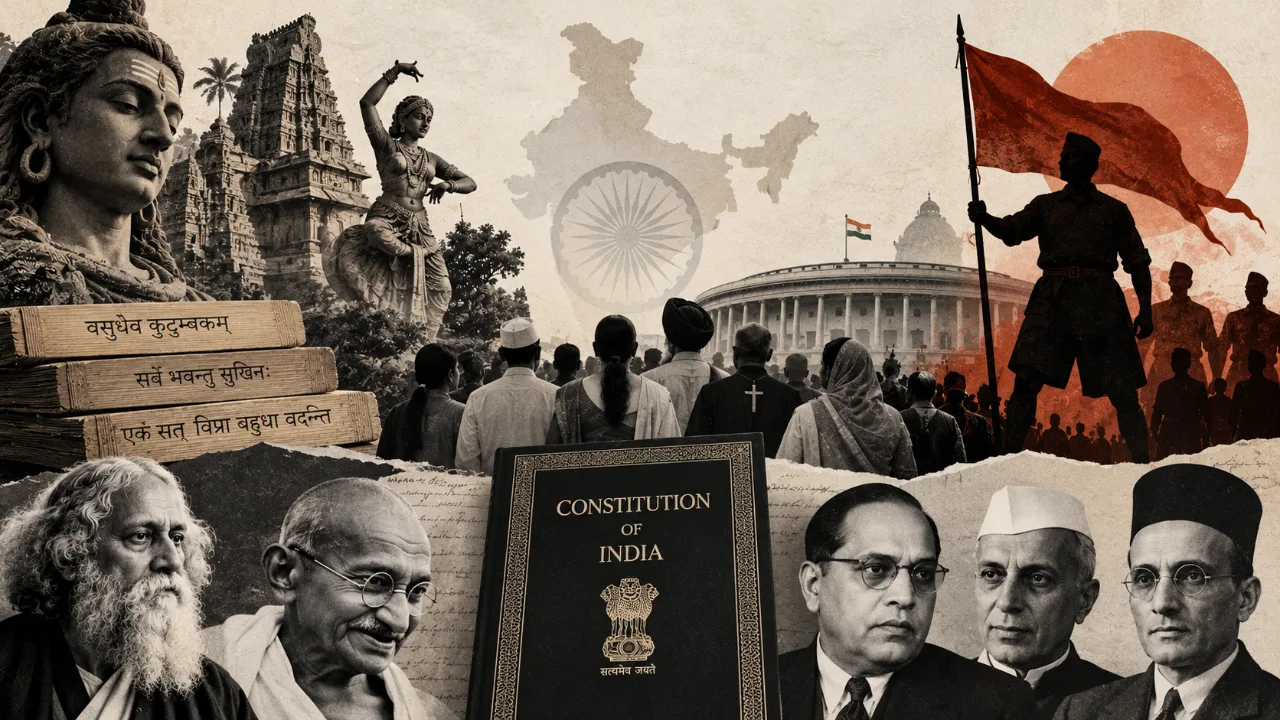
The modern political formulation of Hindutva is particularly associated with Vinayak Damodar Savarkar's 1923 work, Essentials of Hindutva, also known as Hindutva: Who Is a Hindu?
Savarkar explicitly distinguished Hindutva from Hinduism understood narrowly as a religion. He presented Hindutva as a broader conception of Hindu identity involving nation, common descent and civilisation.
One of his most consequential formulations connected India as a pitrubhu—fatherland—with India as a punyabhu—holy land. In this framework, the sacred geography of Hindu traditions, alongside those of Buddhism, Jainism and Sikhism, occupied a distinctive place in defining Hindu nationhood. Muslims and Christians whose sacred geographies lay outside India did not fit his definition in the same way.
Primary source: V. D. Savarkar, Essentials of Hindutva (1923), particularly the discussion of fatherland and holy land.
This distinction has important consequences.
If national identity depends on a shared civilisational history, the idea can include people of different religious beliefs who share that history. But if national belonging also depends on a particular relationship between the land and religious sacredness, some citizens may find themselves placed outside the ideological centre of the nation.
That does not mean every supporter of Hindutva holds identical views about minorities or citizenship. Nor does it mean that all Hindu nationalism can be reduced to one sentence from Savarkar.
It does mean that Savarkar's definition deserves to be examined on its own terms.
The essential question is whether a shared cultural inheritance can be the basis of national unity without becoming a hierarchy of belonging.
4. The Historical Context: India Was Never a Single Cultural Island
India's civilisation developed through interaction, conflict, exchange and adaptation.
The subcontinent contains many linguistic regions, religious traditions, philosophical schools, social structures and political histories. Hindu traditions developed alongside Buddhist, Jain, Sikh, Islamic, Christian, Jewish, Zoroastrian and numerous indigenous and local traditions.
These relationships were not always peaceful or equal. There were wars, religious conflicts, caste hierarchies, political exclusions and episodes of persecution. A serious account of Indian history must acknowledge them rather than romanticise the past.
But conflict is not the whole story.
Trade, architecture, music, language, literature, food, textiles and devotional traditions also developed through contact between communities. Persianate court culture influenced Indian languages and artistic traditions. Bhakti and Sufi movements developed in different settings, sometimes sharing themes of devotion while retaining their distinct theological foundations. Indian philosophical traditions debated one another across centuries.
The point is not that India has always enjoyed perfect harmony. It has not.
The point is that Indian civilisation cannot be adequately explained as the exclusive creation of one religious community, nor can its history be reduced to an uninterrupted conflict between religious blocs.
A nation can acknowledge the central importance of Hindu civilisation in India's history without claiming that every other tradition is secondary to the national story.
Historical inheritance is not the same as exclusive ownership.
5. The Freedom Movement: One Nation, Different Visions
The Indian independence movement was not ideologically uniform. Different leaders offered different answers to the question of what India should become after colonial rule.
Rabindranath Tagore: A Warning Against the Worship of the Nation
In his 1917 essay Nationalism in India, Rabindranath Tagore questioned the tendency to turn the nation into an impersonal machine demanding unquestioning loyalty.
Tagore did not reject India's cultural inheritance. He valued India's intellectual traditions and its capacity to bring different communities into relationship. His concern was that nationalism could become destructive when political organisation, collective pride and competition overwhelmed human relationships.
For Tagore, the challenge was not simply to build a powerful nation. It was to build a society in which human dignity and cultural exchange could flourish.
Reference: Rabindranath Tagore, Nationalism (1917), essay “Nationalism in India.” See the scholarly discussion in Indian Philosophy in English: From Renaissance to Independence, Oxford University Press, pp. 21–36.
Tagore's warning remains relevant to every form of nationalism, religious or otherwise: when love of one's country becomes a demand to distrust outsiders or silence internal disagreement, patriotism risks turning into political conformity.
Mahatma Gandhi: Religion, Ethics and Pluralism
Gandhi's political language was deeply influenced by Hindu traditions, particularly ideas of truth, non-violence, self-discipline and religious duty. Yet he also drew on other religious and ethical traditions.
Gandhi did not believe that national unity required every Indian to share one religious identity. His political vision emphasised cooperation among religious communities, although his religious language and political strategies have also been debated and criticised.
His example illustrates an important distinction: religious inspiration in public life does not necessarily mean that the state must privilege one religion.
A politician can draw ethical principles from Hinduism while defending the equal citizenship of Muslims, Christians, Sikhs, atheists and others.
B. R. Ambedkar: Political Equality Requires Social Equality
B. R. Ambedkar's contribution is indispensable to this debate because he questioned the assumption that cultural unity automatically creates a just society.
In Annihilation of Caste (1936), Ambedkar argued that caste could undermine public spirit, solidarity and the possibility of a society founded on liberty, equality and fraternity.
His criticism was not simply about individual prejudice. He examined how social structures can distribute dignity, opportunity and authority unequally.
Reference: B. R. Ambedkar, Annihilation of Caste (1936), especially the discussion of caste and the concluding section on liberty, equality and fraternity. Columbia University's annotated edition provides the text and historical context.
Ambedkar's challenge is uncomfortable for any politics that treats civilisational pride as sufficient evidence of social justice.
A society may celebrate magnificent temples, philosophical achievements and ancient literature while continuing to discriminate against people on the basis of caste.
National pride cannot substitute for equal dignity.
If cultural nationalism celebrates a civilisation, it must also confront the inequalities that have existed within that civilisation.
Jawaharlal Nehru: A Plural and Secular Republic
Nehru's vision placed considerable emphasis on scientific inquiry, democratic institutions, economic development and a secular political framework.
His approach did not require Indians to abandon their religious or cultural identities. Instead, it sought to prevent the state from treating one religious community as the definitive owner of the nation.
The broader constitutional principle is that citizens may differ in religion, language and culture while remaining equal members of the same political community.
These thinkers disagreed in important ways. They should not be collapsed into a single tradition of Indian nationalism.
Their differences demonstrate that the question of national identity has been contested throughout modern Indian history.
6. The Global Debate: Civic Nationalism Versus Ethnic Nationalism
India's debate is part of a much larger philosophical question.
What makes a nation a nation?
One answer emphasises civic nationalism: a nation is a political community whose members share citizenship, institutions, rights and responsibilities, even when they have different religious or cultural backgrounds.
Another answer emphasises ethnic or cultural nationalism: a nation is rooted in a shared ancestry, language, religion, history or civilisational identity.
These are analytical categories, not perfect descriptions of every country. Most nations combine civic and cultural elements in different proportions.
France has historically developed a strong tradition of republican citizenship, although French debates over language, secularism and national identity remain complicated. Germany's historical experience demonstrates the dangers of defining national belonging through ancestry and ethnic identity. The United States combines constitutional ideals with a contested history of race, immigration and national belonging.
No country perfectly fulfils its declared principles.
The important distinction is not between nations that have culture and nations that do not. Every nation has a culture.
The question is whether cultural identity determines who enjoys equal political standing.
A civic nation can celebrate a majority culture while protecting minority rights. A culturally defined nation may also recognise minorities, but it faces a recurring challenge: how to prevent the majority's identity from becoming the implicit standard against which everyone else is judged.
This is why the distinction between cultural pride and political hierarchy matters.
A country does not have to erase its historical inheritance to protect equal citizenship.
7. The Constitution of India: Can the State Belong Equally to Everyone?
India's constitutional framework provides a way to approach this question.
Article 14 guarantees equality before the law and equal protection of the laws. Article 15 prohibits specified forms of discrimination by the state on grounds including religion, race, caste, sex and place of birth. Article 25 protects freedom of conscience and the freedom to profess, practise and propagate religion, subject to constitutional limitations.
These provisions do not require citizens to become culturally identical. They establish principles governing how the state treats people with different identities.
Official reference: Constitution of India, Articles 14, 15 and 25.
The constitutional question is therefore not whether Hindu traditions should have a place in Indian public life. They unquestionably form a major part of India's cultural and historical inheritance.
The question is whether the state should distinguish between citizens on the basis of religious identity, or whether every citizen should enjoy equal protection regardless of belief.
A Hindu can reasonably want Hindu philosophy taught, temples protected, Sanskrit studied and Indian cultural traditions preserved. Those goals do not automatically conflict with secular constitutional principles.
The conflict arises when public institutions or political arguments imply that a non-Hindu citizen is less Indian, less trustworthy, or less entitled to equal rights because of religion.
A plural republic must allow the majority to preserve its traditions without converting majority identity into a test of citizenship.
8. Why Does Religious Nationalism Become Politically Powerful?
Religious nationalism does not emerge only because politicians manipulate religious feelings. Its appeal can arise from several overlapping historical and social factors.
First, cultural insecurity. Communities may feel that their traditions have been neglected, misrepresented or weakened by colonial rule, social change or globalisation.
Second, historical memory. Accounts of invasion, persecution, conquest and resistance can become powerful sources of collective identity. Such memories may refer to real historical events, but selective storytelling can turn complex histories into permanent narratives of collective grievance.
Third, political mobilisation. Religious symbols, festivals, sacred places and historical figures can help political movements create a sense of shared purpose.
Fourth, social identity. People often derive belonging and dignity from the communities with which they identify. Political movements can strengthen solidarity by defining a clear distinction between the group and those portrayed as outsiders.
Fifth, material concerns. Economic insecurity, unequal opportunities, unemployment and distrust of institutions can interact with cultural anxieties. Religious nationalism may offer a language through which people express broader fears about social status and political recognition.
These factors do not make every religious nationalist intolerant, nor do they mean that every supporter has the same motivation.
Research on Hindu nationalism has examined how political organisations, historical narratives and ordinary social networks contribute to the formation and spread of national identity.
Understanding this process is more useful than assuming that millions of people are motivated by a single emotion or a single political instruction.
The serious question is what political movements do with the identities and grievances they mobilise.
Do they transform cultural confidence into democratic participation and social reform? Or do they turn historical grievance into suspicion of citizens who belong to different communities?
The answer depends on political choices, institutions and the behaviour of leaders and supporters.
9. The Danger of Turning History into a Permanent Battlefield
History is essential to national identity, but it can also be used selectively.
A political narrative may emphasise particular invasions, rulers, religious conflicts or acts of destruction while ignoring periods of cooperation, exchange, internal disagreement and cultural transformation.
The result is a simplified moral map: one community becomes the eternal victim, another becomes the permanent aggressor, and the present generation is expected to inherit the conflicts of the past.
This approach is historically weak because communities are not unchanging political actors across centuries. Religious identities, social institutions, political alliances and cultural practices evolve.
It is also morally dangerous because it transfers collective responsibility from historical individuals and institutions to people who happen to share their religion today.
Historical injustice should be investigated honestly. Monuments, texts, archives and archaeological evidence matter. Wrongdoing should not be excused simply because it was committed by a powerful ruler or someone regarded as part of one's own tradition.
But the opposite principle is equally important: a person cannot be held personally guilty for an event merely because a historical actor belonged to the same religious community.
A mature national identity can acknowledge historical suffering without turning memory into inherited hostility.
The purpose of studying history should be to understand the past more accurately, not to manufacture permanent enemies.
10. Can Hindu Cultural Pride Exist Without Hindutva?
Yes. Hindu cultural pride can exist independently of support for Hindutva as a political ideology.
Someone may take pride in the Upanishads, the Bhagavad Gita, classical dance, temple architecture, devotional poetry, yoga, Sanskrit literature, regional festivals and the philosophical debates of ancient India.
That person may also oppose caste discrimination, defend the equal rights of religious minorities, support constitutional secularism and reject the idea that national belonging should depend on religion.
There is no logical contradiction in these positions.
Likewise, someone may support Hindutva because they believe it strengthens civilisational identity, national unity or cultural confidence. Their reasons should be examined rather than assumed.
The intellectual task is to distinguish cultural attachment from political doctrine and political doctrine from its actual consequences.
A Hindu who disagrees with Hindutva is not necessarily rejecting Hinduism. A supporter of Hindutva is not automatically identical to every other supporter. Yet an ideology's consequences must still be evaluated through its definitions of nationhood, its treatment of minorities, and its relationship with constitutional equality.
The most useful test is practical: does a political vision allow people to belong to the same nation without requiring them to share the same religion?
If the answer is yes, cultural pride and equal citizenship can coexist. If the answer is no, the political project must explain why the religious identity of some citizens should carry greater national authority than that of others.
A Civilisation Is Larger Than Any One Political Ideology
India's cultural inheritance is too diverse to be reduced to a single political doctrine.
Hindu traditions have contributed enormously to India's philosophy, literature, art, architecture, music, ritual life and intellectual history. Their importance does not need to be diminished to recognise that India also belongs equally to citizens from other religious and non-religious backgrounds.
Hindutva is a modern political ideology with a particular account of Hindu nationhood. It must be examined through its own texts, historical development, political arguments and consequences. It should neither be treated as synonymous with every Hindu identity nor shielded from criticism simply because it invokes Hindu civilisation.
Tagore's critique of aggressive nationalism, Ambedkar's insistence on social equality, Nehru's secular constitutional vision, and Savarkar's formulation of Hindu nationhood offer different answers to the question of national belonging.
Their disagreements matter because they expose the real issue: is the nation primarily a cultural inheritance, a political community of equal citizens, or some combination of the two?
India's constitutional framework offers a democratic standard for resolving that question. Cultural traditions may inspire citizens, shape public debate and enrich national life. But political power must remain accountable, and equal citizenship cannot depend on religious conformity.
The deepest test of nationalism is not how proudly it speaks about civilisation, but whether it can protect the dignity of people who do not share the majority's identity.
A civilisation becomes stronger when its traditions can be studied, debated, renewed and criticised without fear. A nation becomes more democratic when no citizen has to prove that their religion makes them sufficiently national.
India need not choose between cultural memory and plural citizenship. Its greater challenge is to preserve both—without allowing the language of national pride to become a hierarchy of belonging.
Official Editorial PDF Edition
Verified PublicationDownload a clean, high-resolution printable copy complete with tables, formulas, and high-res photography. Free for registered readers.
Community Feedback & Editorial Ratings
Based on 1 community review
All Reader Reviews (1)Latest reader perspectives
Very deep thought