










AI & the Future of Financial Systems: How Artificial Intelligence Could Reshape Global Finance by 2035
From AI-Powered Banking and Fraud Prevention to Financial Stability Risks, Job Disruption and India's Regulatory Challenges
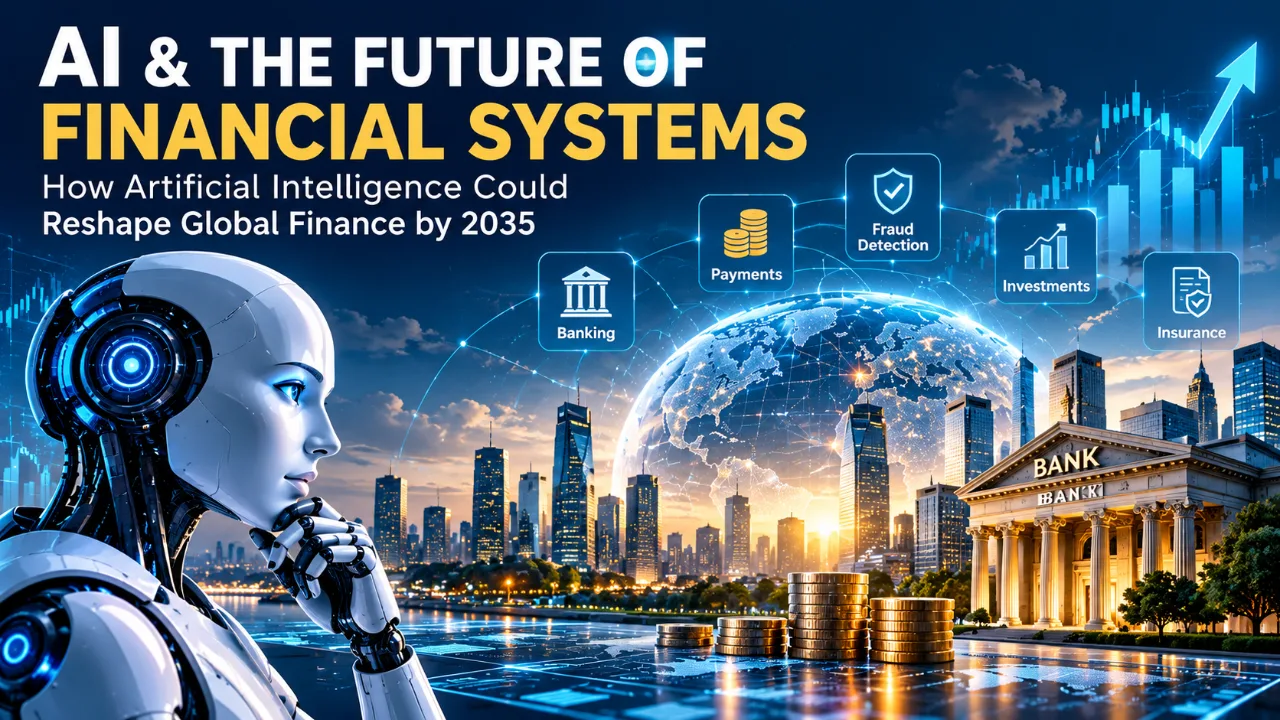
AI & the Future of Financial Systems: How Artificial Intelligence Could Reshape Global Finance by 2035
From AI-powered banking and fraud prevention to financial stability risks, job disruption and India’s regulatory challenges.
Artificial intelligence is moving beyond chatbots into the core of global finance. Banks, insurers, payment networks and regulators are exploring AI for fraud detection, credit assessment, compliance and customer services. But autonomous AI agents, cyber threats, workforce disruption and concentrated technology dependencies are creating new challenges. Here is how AI could transform the financial system by 2035—and what it means for India.
Introduction: A New Phase in Financial Technology
The global financial system is approaching a significant technological transition. For centuries, finance has relied on information to assess creditworthiness, price risk, move money and allocate capital. Artificial intelligence (AI) is changing how quickly and efficiently these activities can be performed.
Traditional financial technology digitised transactions and records. AI goes further by analysing patterns, generating insights, processing documents and supporting decisions. Generative AI can help employees interpret complex financial information, while machine-learning systems can identify unusual transactions and potential fraud.
A particularly important development is the emergence of AI agents—systems designed to carry out multi-step tasks with varying degrees of autonomy. In the future, such systems could help customers compare financial products, organise payments and manage routine financial activities.
However, greater automation does not automatically mean a safer financial system. Errors, cyberattacks, biased algorithms and interconnected technology providers could introduce new vulnerabilities.
The central question is therefore not simply how much AI finance can adopt, but how institutions can deploy it without compromising financial stability, consumer protection and public trust.
1. How Financial Technology Evolved
The relationship between finance and technology has developed over several centuries.
From ledgers to digital banking
Early financial systems relied on physical records, coins, merchant networks and credit arrangements. Banking institutions gradually developed mechanisms for deposits, lending and payments. Telegraphs and electronic communications made financial information travel faster, while computers transformed accounting and transaction processing.
ATMs, payment cards and electronic funds transfers expanded access to banking services. Internet banking and smartphones subsequently enabled customers to access financial services without visiting a branch.
The growth of digital payments, cloud computing, application programming interfaces (APIs) and financial technology companies created the infrastructure on which many modern AI applications now depend.
From automation to intelligence
Earlier automation generally followed predefined rules. Modern AI can identify patterns in large datasets, process unstructured documents and generate responses in natural language.
This represents an evolution from digitising financial activity to supporting and, in carefully controlled situations, automating parts of financial decision-making.
The Bank for International Settlements (BIS) has examined how successive generations of AI may transform financial intermediation, insurance, asset management and payments. Its research also highlights the importance of governance, transparency, fairness and human oversight.
2. How the Present Financial System Works
The financial system connects households, businesses, governments, financial institutions and investors.
Banks accept deposits, provide loans and facilitate payments. Insurance companies pool specified risks and pay eligible claims. Capital markets enable organisations to raise funds and investors to buy and sell financial assets. Payment systems transfer money, while clearing and settlement mechanisms reconcile financial obligations.
Central banks influence monetary conditions and support important parts of the monetary and payment infrastructure. Financial regulators supervise institutions, markets and consumer protection within their respective jurisdictions.
These activities depend on reliable information, secure infrastructure, liquidity, enforceable contracts and public confidence.
AI can improve the processing of information across this system. It cannot independently replace the capital requirements of banks, the liquidity needed to meet obligations, the legal rights of customers or the institutional safeguards that maintain trust.
3. Where AI Could Transform Finance
AI-powered banking
Banks can use AI to assist with customer support, document verification, loan processing, transaction monitoring and operational reporting. Conversational systems may help customers understand account information and navigate banking services.
AI-assisted credit analysis can help evaluate financial information, but lenders must still assess whether their methods are lawful, accurate and fair.
Fraud detection and anti-money laundering
Conventional fraud systems often depend on predefined rules. Machine-learning models can analyse transaction patterns, relationships between accounts and unusual behaviour to identify activity requiring further investigation.
AI can also help compliance teams prioritise alerts and review documents. Nevertheless, false positives may inconvenience legitimate customers, while false negatives can allow fraudulent transactions to pass undetected.
Insurance and investment management
Insurers can use AI to support document extraction, claims triage, underwriting analysis and fraud investigation. Investment professionals can use AI to summarise research, analyse scenarios and support risk monitoring.
These applications should remain subject to appropriate validation and oversight, especially where an automated recommendation could materially affect a person's financial position.
The rise of AI agents
AI agents could eventually perform more complex tasks than conventional chatbots. For example, an authorised system might compare payment options, prepare a transfer and request customer approval before execution.
The critical distinction is between recommending an action and having permission to carry it out. Access to financial accounts, the ability to move funds and authority to make binding decisions require strict controls.
4. Why AI Could Make Finance More Efficient
AI offers several potential benefits:
Lower processing costs: Automating repetitive tasks can reduce manual work and shorten processing times.
Earlier fraud detection: Models can identify suspicious patterns across large volumes of transactions.
Improved customer service: AI assistants can provide round-the-clock responses to routine questions.
Better risk analysis: Institutions can use data to support credit, insurance and operational-risk assessments.
Wider financial inclusion: Carefully designed systems may help institutions serve customers with limited conventional credit histories.
More effective compliance: AI can assist with document review, monitoring and the prioritisation of investigations.
These benefits are not guaranteed. Outcomes depend on data quality, implementation costs, system reliability, employee training and the effectiveness of safeguards.
5. The Risks: When Automation Becomes a Financial Vulnerability
Cybersecurity and financial fraud
AI can help defenders identify attacks, but criminals may also use it to create convincing phishing messages, impersonate customers and generate synthetic identities.
Financial institutions need strong identity verification, transaction controls, secure system design and incident-response procedures.
Algorithmic bias and exclusion
AI models can reproduce patterns of discrimination present in historical data. Even when sensitive characteristics are excluded, other variables may act as proxies.
Credit decisions and insurance assessments therefore require careful testing, appropriate explanations and mechanisms for challenging incorrect outcomes.
Model errors and hallucinations
Generative AI may produce plausible but inaccurate information. In finance, an incorrect interpretation of a contract, regulation or customer instruction can have serious consequences.
Institutions should verify important outputs against reliable sources and prevent unvalidated responses from triggering consequential actions.
Systemic risk and concentration
If many institutions rely on similar models, data sources or technology providers, they may react to market developments in similar ways. This could amplify volatility or create correlated risks.
Dependence on a small number of cloud, computing and AI providers may also create operational vulnerabilities.
The financial risks of the AI investment boom
A further concern is the financial structure supporting AI investment itself. On 19 October 2026, Financial Express reported on the IMF's October 2026 Global Financial Stability Report and its concerns about interconnected AI financing arrangements, debt exposure and future revenue commitments.
Such structures may create vulnerabilities if expected AI revenues fail to materialise. This is distinct from the operational risks of using AI inside banks, but it demonstrates how AI can affect financial stability through both technology adoption and investment markets.
6. Will AI Destroy Jobs or Create New Opportunities?
AI is likely to change the tasks performed by financial-sector employees. Routine data entry, standard document processing, basic reporting and some first-line customer queries may become increasingly automated.
However, automation does not necessarily eliminate an entire occupation. Many jobs combine routine tasks with judgement, customer relationships, negotiation, exception handling and accountability.
Potentially growing areas include:
AI engineering and financial-data analysis.
Model validation and AI risk management.
Cybersecurity and digital identity protection.
AI governance, compliance and auditing.
Financial product design and human-centred service development.
Technology integration and responsible AI implementation.
Employees may need to develop AI literacy alongside financial knowledge, communication skills, critical thinking and the ability to verify machine-generated outputs.
What do the employment projections show?
The World Economic Forum's Future of Jobs Report 2025 projects that broad economic and technological trends could create 170 million jobs and displace 92 million jobs worldwide by 2030, producing a projected net increase of 78 million.
These figures cover the broader labour market. They are not a forecast of finance-sector jobs alone, nor do they attribute every projected change directly to AI.
The precise number of financial jobs that will disappear or emerge by 2035 remains uncertain. A credible assessment must distinguish between jobs exposed to automation, jobs actually eliminated, newly created roles and existing jobs transformed by AI.
7. India’s Financial System: Opportunities and Challenges
India provides an important setting for understanding AI-driven financial transformation. Digital payments, mobile banking, financial technology companies and expanding digital infrastructure have changed how millions of people interact with financial services.
AI could support fraud detection, customer assistance, credit assessment, compliance monitoring and the analysis of suspicious transaction networks. It may also help financial institutions serve customers across different languages and levels of digital literacy.
At the same time, India must address digital fraud, privacy, unequal access to technology, model bias and the risks associated with automated decisions.
The role of the RBI and SEBI
The Reserve Bank of India (RBI) supervises banking and important parts of the payment system. The Securities and Exchange Board of India (SEBI) regulates securities markets and relevant market participants.
Their respective responsibilities make governance, consumer protection, cybersecurity and market integrity central to responsible AI adoption.
In an October 2025 address at the Global Fintech Fest, RBI Deputy Governor T. Rabi Sankar discussed the opportunities and risks of responsible AI in finance. His remarks highlighted potential improvements in financial access, fraud detection and operational efficiency, alongside concerns involving privacy, fairness and accountability.
India's AI policy challenge is to encourage useful innovation while ensuring that financial institutions remain responsible for decisions made with AI assistance.
8. The Regulatory Landscape
AI in finance does not operate outside existing law. Depending on the application and jurisdiction, institutions may need to comply with banking, securities, insurance, data-protection, cybersecurity, outsourcing and consumer-protection requirements.
The European Union's AI Act establishes a risk-based framework for AI systems, with obligations depending on the system's classification, the role of the organisation and applicable implementation dates.
International bodies such as the BIS and the Financial Stability Board have also examined AI-related risks, including third-party concentration, opaque models, cyber vulnerabilities and the potential amplification of financial instability.
For India, institutions must monitor applicable RBI and SEBI directions, relevant data-protection requirements and other laws in force. The precise obligations depend on the activity and the latest regulatory position.
Effective governance should include an inventory of AI systems, accountable owners, risk assessments, independent testing, documentation, supplier oversight, incident reporting and appropriate human review.
9. What Could Finance Look Like by 2035?
Three broad scenarios illustrate the possibilities.
Scenario A: Gradual integration. AI becomes a routine assistant for banking, insurance, investment research and compliance. Human employees continue to manage complex decisions and exceptions.
Scenario B: More autonomous services. Reliable AI agents perform additional authorised tasks across financial platforms. This could make services more convenient but would require stronger identity, permission and transaction controls.
Scenario C: Uneven adoption. Cyber incidents, unreliable models, regulatory uncertainty or public distrust slow adoption. Large institutions with stronger infrastructure may move faster than smaller organisations.
These scenarios are possibilities rather than predictions. Actual outcomes will depend on technological progress, institutional investment, competition, regulation and public acceptance.
10. The Way Forward: Responsible AI in Finance
A responsible AI financial system needs more than powerful models.
First, institutions must establish clear accountability for AI-supported decisions. Second, they must protect customer data and test models for accuracy, bias and robustness. Third, high-impact decisions need appropriate explanations, human review and routes for customers to challenge errors.
Financial institutions should also maintain fallback systems, monitor critical technology providers and prepare for cyber incidents or model failures.
Governments, regulators, employers and educational institutions must support workforce development so that people can adapt as financial jobs change.
The ultimate objective should be to combine the speed and analytical capacity of AI with the judgement, responsibility and public accountability required by finance.
Conclusion
Artificial intelligence could reshape global finance by changing how institutions assess risk, prevent fraud, deliver customer services and process financial information. It could improve efficiency and inclusion, but it could also introduce new cyber threats, discriminatory outcomes and systemic vulnerabilities.
The future of financial employment will involve both displacement and the creation or transformation of roles. Exact sector-wide job forecasts remain uncertain, making reskilling and evidence-based workforce planning essential.
For India and the rest of the world, the central challenge is to build a financial system that is innovative without becoming opaque, automated without becoming unaccountable, and efficient without sacrificing trust.
The future of finance will depend not only on what AI can do, but on how responsibly people choose to use it.
Disclaimer: This article is for educational and informational purposes. It does not constitute financial, investment or legal advice.
Official Editorial PDF Edition
Verified PublicationDownload a clean, high-resolution printable copy complete with tables, formulas, and high-res photography. Free for registered readers.
Community Feedback & Editorial Ratings
All Reader Reviews (0)
No reader reviews yet for this story.
Be the first to share your rating and perspective!