









Symphony of the Unseen: Brian Greene's 'The Elegant Universe' and the Architecture of Reality
Mallika Jana Hatai
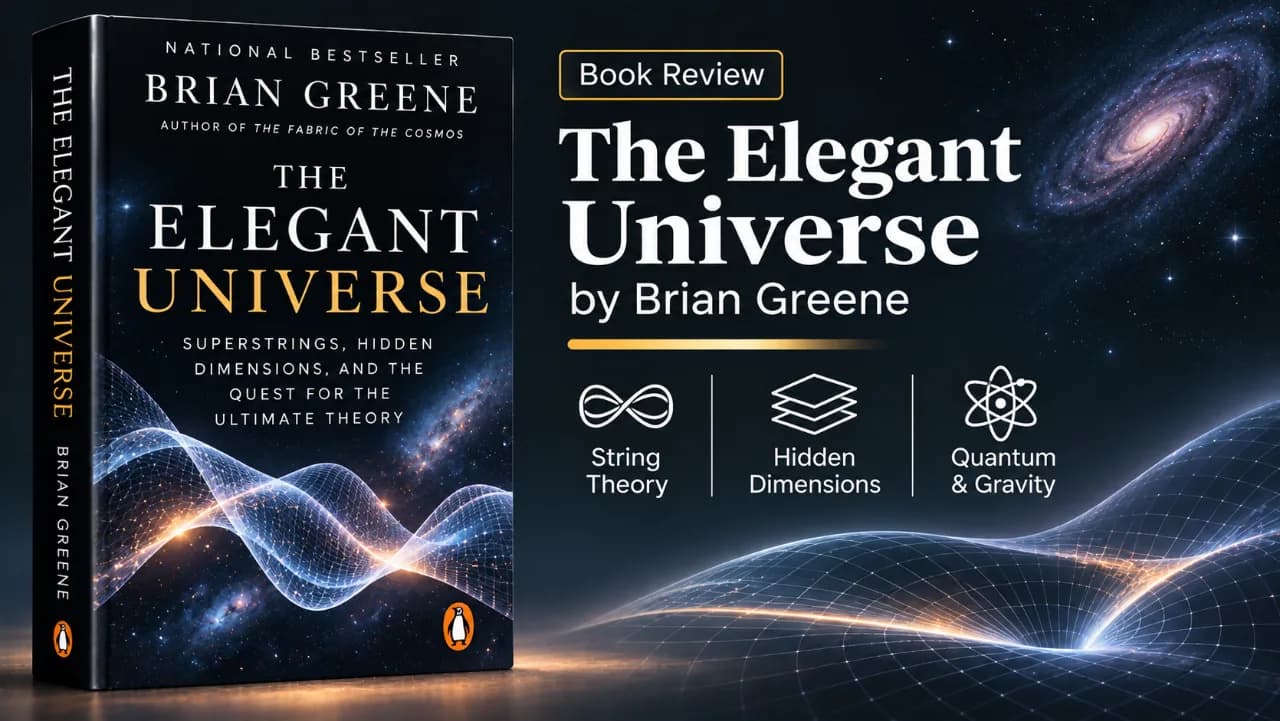
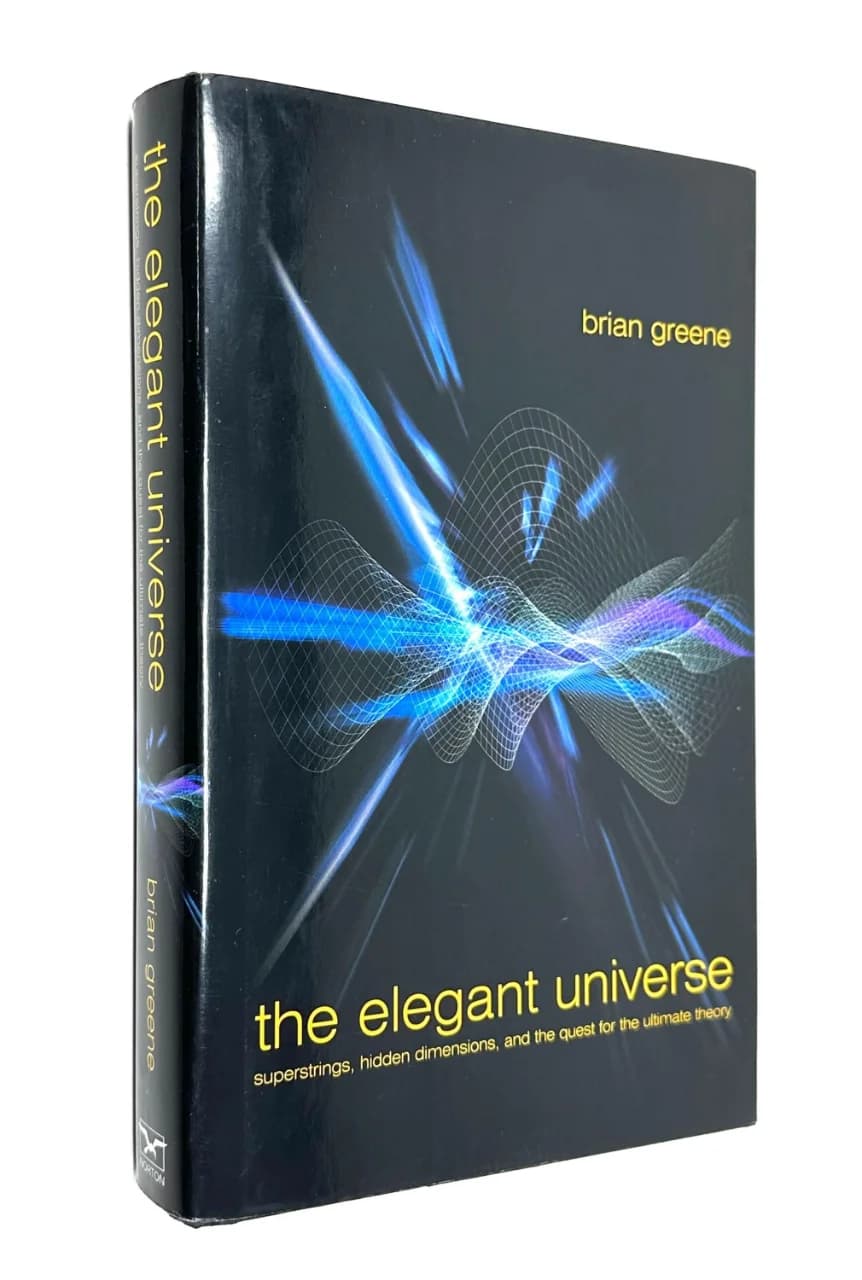
The Elegant Universe: Superstrings, Hidden Dimensions, and the Quest for the Ultimate Theory
Author: Brian Greene
Publisher: W. W. Norton & Company (1999)
Inclusive of all taxes
Narrative Vision & Central Thesis
At the close of the twentieth century, theoretical physics found itself standing before a breathtaking precipice: the irreconcilable divide between Albert Einstein's smooth, geometric universe of general relativity and the chaotic, probabilistic froth of quantum mechanics. In The Elegant Universe, Brian Greene undertakes nothing less than the cartography of this intellectual frontier. His central thesis argues that superstring theory—the proposition that fundamental reality consists not of zero-dimensional point particles, but of infinitesimally tiny, vibrating filamentary strings—furnishes the long-sought bridge across this cosmological chasm.
Greene orchestrates this complex narrative not as an impenetrable mathematical treatise, but as a classic detective story of science. Readers are guided from the established triumphs of early modern physics through the baffling paradoxes of the Planck scale, arriving at the audacious frontier where space and time cease to be immutable backdrops and instead become dynamic, folded tapestries.
Literary Style & The Art of Analogy
Translating non-Euclidean geometry and Calabi-Yau manifolds into prose accessible to the non-specialist requires extraordinary rhetorical craft. Greene's primary literary gift is his mastery of conceptual metaphor. Rather than relying on esoteric equations, he constructs intuitive, visual vignettes that domesticate the absurdities of the micro-world:
- The Ant on the Garden Hose: An enduring illustration demonstrating how macroscopic dimensions of space can appear expansive and flat while microscopic, curled-up dimensions remain imperceptible to the naked eye.
- The Cosmic Symphony: An evocative auditory paradigm wherein elementary particles—quarks, electrons, and photons—are reframed as diverse musical notes generated by a single vibrating instrument of pure energy.
- The Tear in Spacetime: A cinematic journey through quantum foam, illustrating how strings act as cosmic buffers against the catastrophic singularities predicted by classical relativity.
"The universe is a cosmic symphony, and the laws of physics are the harmonies that emerge from the vibration of fundamental strings."
Key Strengths & Thematic Resonance
Beyond its explanatory clarity, The Elegant Universe excels in conveying the aesthetic impulse that drives theoretical research. Greene demonstrates that physicists are not mere calculators; they are driven by a deep-seated conviction that nature at its deepest level exhibits symmetry, economy, and elegance. The book meticulously chronicles the "Second Superstring Revolution" and the birth of M-theory under Edward Witten, showing how five distinct mathematical formulations converged into facets of a single, unified eleven-dimensional jewel.
Greene avoids dry pedantry by keeping the human element in constant focus. The intellectual rivalries, historic dead ends, and exhilarating breakthroughs of twentieth-century physicists inject dramatic momentum into what could otherwise have been a glacial conceptual exercise.
Critical Observations: The Empirical Dilemma
Viewed through a contemporary lens, the work invites a critical caveat that has only deepened with time: the problem of falsifiability. While Greene presents superstring theory with infectious optimism, string theory remains stubbornly divorced from empirical validation. Because the Planck length sits far beyond the reach of terrestrial particle colliders like CERN's Large Hadron Collider, the theory risks migrating from empirical physics into mathematical philosophy.
To Greene's credit, he acknowledges these experimental hurdles, though his lyrical devotion to the theory occasionally skirts the boundary between objective exposition and partisan advocacy. Readers looking for a balanced skepticism will find the theoretical counterarguments somewhat subdued beneath the sheen of the string paradigm's sheer aesthetic allure.
Final Verdict & Enduring Legacy
Even decades after its original publication, The Elegant Universe stands alongside Stephen Hawking's A Brief History of Time and Carl Sagan's Cosmos as an indispensable classic of scientific literature. Greene's prose proves that the most bewildering truths of modern physics need not remain locked behind the gates of higher mathematics. It is an essential read for anyone who has ever gazed up at the night sky and wondered what quiet music holds the fabric of the universe together.
Enjoyed this review? Order the physical copy today.
Secure your printed edition with fast doorstep courier delivery.
Related Books You May Also Like

Reader Reviews & Ratings (0)
Real feedback and verified opinions from readers who purchased or read this title.
No reader reviews yet for this publication.
The Elegant Universe: Superstrings, Hidden Dimensions, and the Quest for the Ultimate Theory